What is a boilie – and why did it revolutionise carp fishing?
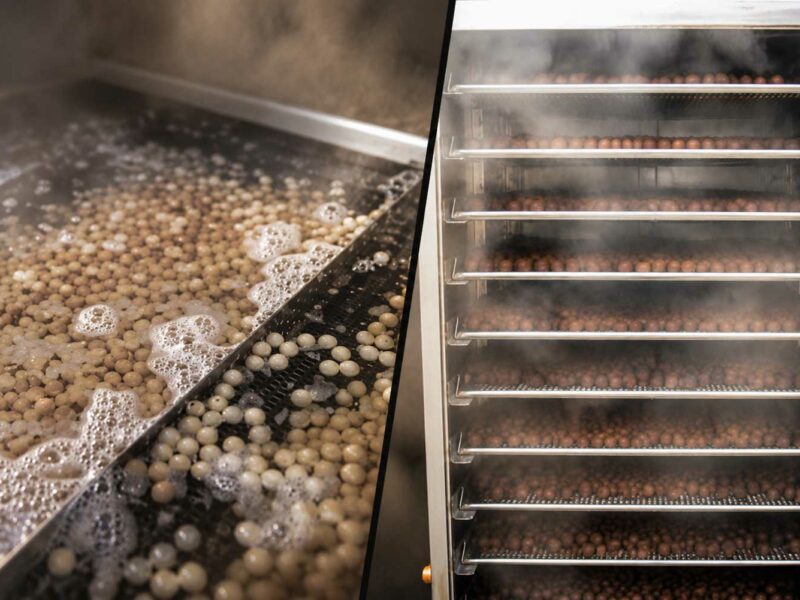
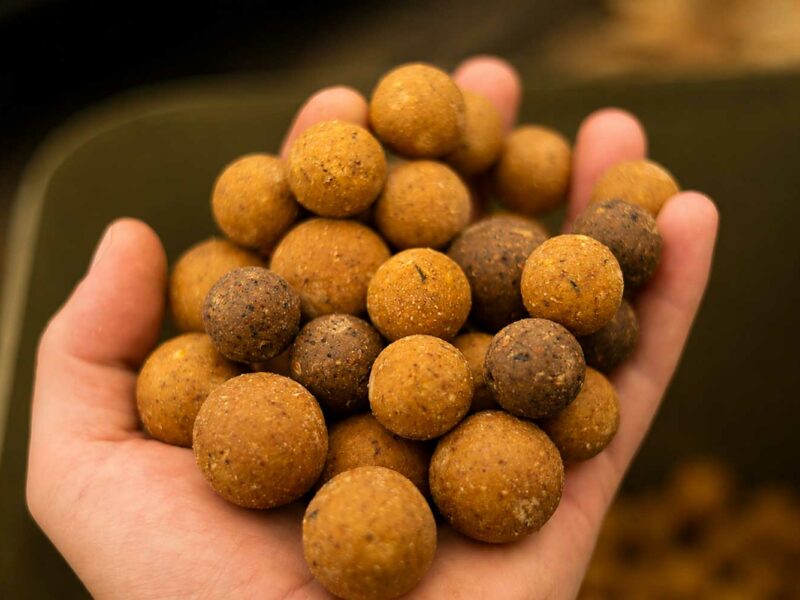
A boilie is a round, hard-boiled carp bait made from a protein paste. The name comes from the English “to boil”: the finished paste is rolled into balls and dropped into boiling water for a short time. The protein sets, the outer skin hardens – and you get a bait that nuisance fish physically can’t open, but that carp crush easily with their pharyngeal teeth.
Carp digestion – why boilies work differently than you think
Carp have no true stomach. They do, however, have a gall bladder that stores and concentrates bile — when needed, it is released straight into the gut to break down the fats the fish has eaten. So fat digestion works — just without the acidic environment of a true stomach.
What this means for boilies: there is no acidic pre-digestion to break down poorly soluble proteins. Whatever the enzymes in the gut can’t digest is excreted or puts a strain on the fish. Easily digestible ingredients — hydrolysates, milk proteins, enzymatically broken-down meals — go straight to work in the gut.
On top of that, smell alone doesn’t decide things for a carp — taste does. Smell brings the carp to the bait. Taste decides whether it keeps it or spits it out.
Then there are mechanical receptors in the mouth: a bait that’s too hard can tell the carp — spit that out, it isn’t food. A boilie should only be as hard as necessary, not as hard as possible.
5 factors – why a carp picks up a bait and eats it
According to Scottish researchers — cited by Robert Arlinghaus and Jürgen Meyer (2001) — five factors have to be right for a carp to feed:
1. Appearance — size, shape, colour. Whether something looks like food depends on the carp’s experience. Naive carp that have never seen boilies won’t take them straight away. Conditioned carp know boilies as food and react instantly — that’s the basis of the bait signature (“Bait DNA”).
2. Smell — a long-range sense. Water-soluble scent compounds draw carp in from a distance. Through taste buds on its barbels and body surface, a carp also picks up taste stimuli at a distance — up to about 5 metres.
3. Feel — how does the material feel? Hard or soft, moist, dry, rough or smooth. Soft baits are preferred — scientifically confirmed by Klefoth & Arlinghaus (2013): carp of both genotypes preferred sweetcorn over hard pellets because of its softer texture.
4. Taste — a close-range sense. Sorting happens in the mouth. The deciding factor in whether the bait is kept or spat out.
5. Satiation — the most underestimated factor. A hungry carp takes risks, is less selective and will even eat unfamiliar baits. A full carp is highly selective. This explains scientifically why baiting too heavily cuts the number of bites — not because the carp have gone, but because they’re full. Lab trials (Klefoth/Arlinghaus 2013) showed that fish without a natural food supply (hungry) were dramatically easier to catch. It also explains why carp on a commercial fishery are easier to catch because food is scarce — and why high summer, with plenty of natural food, often brings poor bites.
How the boilie changed the carp world
Developed in England in the 1970s by Fred Wilton as homemade protein balls made from fishmeal, egg and flavour.
It was the invention of the hair rig by Kevin Maddocks and Len Middleton in the late 1970s that made the boilie truly effective: the bait hangs freely on the hair, with the hook hidden alongside it. Carp pick it up without suspicion – and notice the trap too late. Ever since, the boilie has been the standard bait for big carp.
What makes a boilie work isn’t the flavour alone – it’s the interplay of binding and solubility. A boilie has to be stable enough to stand up to nuisance fish, crayfish and casting. At the same time, it has to release water-soluble attractants into the water continuously. These aren’t conflicting demands – they’re the real art of boilie design.
Boilie shapes – which shape for which job?
Not all boilies are the same. Shape and buoyancy decide how the bait sits – and that often makes the difference between a fish and a blank.

Standard boilie (sinking) – the classic round bait that sinks to the bottom. Presented on a hair rig and sits among the feed boilies. First choice for all normal bottoms.
Feed boilie – like a standard boilie, but designed for use in large quantities. Softer, more water-soluble, releases more attractants. Not for the hair rig – it’s for baiting with a spod, baiting spoon or bait boat.
Pop-up boilie – the bait floats. Cork dust or air pockets in the paste make it lighter than water. Balanced with a small split shot, it floats a few centimetres off the bottom. Ideal over silty or heavily weeded bottoms. Pop-ups are seen as a bait for bigger carp – when and why is explained in the guide Pop-up boilies.
Wafter boilie – critically balanced: it almost cancels out the weight of the hook and settles weightlessly on the bottom. Cautious carp suck it in just as easily as a loose feed boilie – so the hookbait goes further back into the mouth. A very effective hookbait in almost every situation – especially good on soft bottoms. Rigs, sizes and how to use them are covered in the guide Wafter boilies.
Dumbbell – two half-spheres. A different silhouette in the bed of bait, spins as it falls, a visual trigger. As a pop-up dumbbell, one of the most eye-catching hookbaits there is.
Barrel (cylinder shape) – sits differently on the bottom than a round bait, often used when spodding.
Snowman rig – not a shape but a combination: a bottom bait underneath, a smaller pop-up on top. The bait hovers weightlessly. Visually very eye-catching, especially with a coloured pop-up on a natural feed boilie.
Zig rig – not a classic boilie, but buoyant material on a long hooklink. It fishes up in the water column, set to a specific depth. For carp holding high in the water.
Boilie types – the main categories
Fishmeal boilies (HNV – high nutritional value) – high protein content, strong smell, draws carp in from long range. LT fishmeal (low temperature) is more digestible than HT fishmeal. CC Moore Pacific Tuna, Mikbaits Gangster, Supreme Baits – all HNV examples.
Birdfood boilies – based on birdfoods such as CLO, Nistka and coconut meal. The porous texture releases attractants quickly. Robin Red from Haiths is the best-known ingredient: spicy and hot, deep dark red, catching for decades. Ideal for fast attraction.
Milk protein boilies – casein, lactalbumin, sodium caseinate. Easily digestible, creamy and slightly sweet, and not just ideal for cold water. Carp don’t fill up and come back quickly.
Fruit boilies – natural fruit flavours: pineapple, strawberry, mango. Ideal in summer for actively feeding carp. Fluoro colours make them top pop-ups.
Krill boilies – krill meal (55–65% protein), omega-3 fatty acids (EPA, DHA), a salty marine smell. Intensely red. Catch all year round, especially in autumn and winter. Carp know krill as natural food.
Bloodworm boilies (chironomid larvae) – one of the most natural boilies of all. Red midge larvae (Chironomidae) are one of the main natural food items of carp. They live in the silt on the bottom. A boilie with real midge larvae plus bloodworm extract and butyric acid sends exactly the signal carp recognise as “real food”. On silty waters with a natural bloodworm population, often the most effective approach. The red colour – often from Robin Red – mimics the natural colour of the larvae.
Silkworm meal boilies (insect protein) – discovered in koi farming and increasingly used on the carp scene. Silkworm meal is made from the ground pupae of the silkworm (Bombyx mori) – a 100% natural product. Nutritional profile: ~50–55% protein, ~25–30% fat, a complete amino acid profile. Inclusion rate up to 20% of the mix. A strong smell of its own – an acquired taste for humans, a direct feeding signal for carp.
Liver boilies – beef liver meal and beef liver extract. An intense, savoury smell and high water solubility. Beef liver is the number one among the liver types. It releases betaine in the water. Can be used all year round and is known for catching big, old carp.
Hemp boilies – hemp meal is rich in omega-3 and omega-6 fatty acids, amino acids, vitamins and minerals. Its strong, nutty smell works on carp like a magnet. Hemp also contains mucilage that aids digestion – carp that have eaten hemp once will actively look for it. Inclusion rate max. 20% of the mix because of its low density.
Spice boilies – chilli, garlic, curry, paprika. Robin Red belongs here too. Hot active compounds get the fish going. Particularly strong in the transitional seasons and early autumn.
The key ingredients in detail
Lactalbumin + egg albumin – structure and solubility are the architects of the boilie. Lactalbumin gives the boilie an elastic structure that lets water in without the bait falling apart. Egg albumin binds the ingredients during boiling. Together they create the paradox: stable, yet active. Water gets in, attractants get out – the boilie keeps its shape but works from the inside.
Squid meal – 95% pepsin digestibility, one of the most easily digestible marine proteins. Rich in essential amino acids: lysine, leucine, arginine, methionine, glutamic acid. A high proportion of highly water-soluble peptides. Clearly noticeable from just 5–8% of the mix, can be used at up to 15%. The squid + Scopex flavour combination was Nash Scopex Squid – one of the best-known boilies in history.
Beef liver meal + liver extract – beef liver releases betaine (N-trimethylglycine) directly into the water. High water solubility is the key advantage of beef liver meal over other types of liver. Inclusion rate 5–10% of the mix as a meal, 20–40g/kg as a liquid extract.
Krill ester blend – phospholipid-bound omega-3 fatty acids: up to 10× faster to dissolve in water than triglycerides. Contains DMPT (dimethyl-β-propiothetin) – a sulphur-containing marine compound regarded as a powerful feeding trigger in fish.
GLM (green-lipped mussel) – a marine protein signal that carp recognise as real food. Contains a complete amino acid profile and natural betaine. Inclusion rate 2–5% of pure mussel meat extract with no shell content.
Belachan (fermented shrimp) – a South-East Asian shrimp paste. Fermentation produces free amino acids, peptides and natural N-butyric acid. Water-soluble compounds diffuse into the water instantly. Available as a block (75g/kg dry mix), liquid or powder.
Fermented grains – enzymatic breakdown converts starch molecules into glucose, maltose and short-chain carbohydrates. These are water-soluble — unlike unfermented flour, which has no pulling power. At the same time, organic acids (butyric acid!), alcohols and other attractive compounds are formed. Particularly effective at low water temperatures.
Hemp meal and pumpkin seed meal – both are left over as press cake from oil production and cost considerably less than the respective oils — with an almost identical ingredient profile. Hemp meal contains ~30–35% protein, an ideal omega-3/omega-6 ratio (approx. 3:1), mucilage that aids digestion and the nutty, earthy smell that carp find so attractive. Pumpkin seed meal delivers ~35–40% protein, ~25% residual fat (of which ~55% is linoleic acid/omega-6), an intense nutty aroma and the characteristic dark green to brown colour from the chlorophyll it contains. Both can go straight into the boilie mix — pumpkin seed meal at up to 15%, hemp meal at up to 20%. As with the oils: at water temperatures below 10°C, fats disperse slowly — so use these meals sparingly then or add hydrolysates.
CSL (corn steep liquor) – a by-product of maize starch production. Sweet and fermented, rich in free amino acids and carbohydrates. Gives off a broad attraction cloud instantly. To this day one of the cheapest and most effective attractors for baiting.
NHDC (neohesperidin dihydrochalcone) – an extreme sweetener, roughly 250–1,800× sweeter than sugar depending on concentration. Clearly noticeable at just 0.01% of the mix.
DMPT – a sulphur-containing marine compound from aquaculture research. Dissolves extremely quickly in water. Identified by Japanese scientists as a stronger attractor than some amino acids.
Niger seed – a black oilseed from Guizotia abyssinica. Main function: structure. The seeds create cavities and channels in the boilie for faster release of attractants. Fat content ~40%, linoleic acid (omega-6). Third effect: crunch when crushed. Inclusion rate max. 5% of the boilie mix.
Calf milk replacer – the secret boilie ingredient Arlinghaus already knew about
Calf milk replacer (known in Austria and Germany as “Kälberstarter”) is one of the least known and at the same time most effective boilie ingredients — and that’s no coincidence: as early as 1999, in “Boilies Hausgemacht”, Jürgen Meyer and Robert Arlinghaus used Vitamealo with the explicit note “this is a calf milk” — as well as Big C Spray as a “milk powder used in livestock feeding”. What you can buy today as calf milk replacer at the farm store was recognised long ago as a key ingredient by the pioneers of science-based boilie fishing.
What calf milk replacer contains — and why carp love it:
50% skimmed milk powder — 80% casein, 20% lactalbumin/whey protein. Chemoreceptors in the carp’s mouth instantly identify casein as high-quality food protein. Lactalbumin has the highest digestibility of all protein sources.
Lactose and glucose — milk sugar and fast-release energy. An instant sweet attraction cloud without synthetic sweetener. A natural sweet taste that carp from pond farms know.
Essential amino acids — lysine, methionine, threonine, tryptophan, valine. Exactly the limiting amino acids that carp must take in through their food.
Betaine — added to many calf milk replacers as a growth stimulant. The same active ingredient that’s treated as a secret weapon on the carp scene — in calf milk replacer it’s industrially standardised and cheap to buy.
Lecithin — a natural emulsifier that solves the oil/water problem in the boilie mix automatically. Contains the full range of B vitamins — exactly like brewer’s yeast extract.
The practical advantage: a 25-kg sack of calf milk replacer from an agricultural supplier costs a fraction of the price of high-quality boilie meals and contains many of the same active ingredients. Available from agricultural co-operatives and farm stores such as Lagerhaus and Raiffeisen. Inclusion rate in the mix: 10–20% as a partial replacement for casein or lactalbumin. For winter and spring one of the cheapest and most effective boilie ingredients of all.
Easy to digest vs. hard to digest – eat, digest, come back
This is the core principle behind one of the most important carp fishing strategies: an easily digestible boilie passes through the carp’s gut quickly. The fish is hungry again and comes back to the baited spot. A hard-to-digest fishmeal boilie fills the fish up more – but the carp comes back less often.


Easy to digest: milk proteins (casein, lactalbumin, sodium caseinate), calf milk replacer, hydrolysed fish protein, carbohydrate boilies (semolina, soft wheat, maize), betaine.
Harder to digest: HT fishmeal, LT fishmeal in large amounts, soya protein, indigestible fibre, poorly soluble synthetic proteins.
Rule of thumb: in winter and spring → easily digestible milk proteins + carbohydrates. In autumn → protein-rich fishmeal boilies for baiting campaigns. In high summer, cut HNV quantities right back (oxygen, ammonia).
Egg albumin and lactalbumin do two jobs at once: they bind and structure the boilie – but still let water in without the bait falling apart. That’s the balance that separates a good boilie from a bad one.
What carp see – colour, UV light and the senses
Carp are tetrachromats – four types of cone in the eye (humans have three). They see UV light. UV-reactive pop-ups glow underwater for carp with a dimension we can’t perceive.
The carp’s 4 cone types: UV (~360nm), blue (~450nm), green (~530nm), red (~620nm). Karl von Frisch showed as early as 1913 that cyprinid fish have highly developed colour vision. Whitmore & Bowmaker (1989) demonstrated UV cones in carp using microspectrophotometry. Neumeyer (1992) confirmed tetrachromatic colour vision through behavioural experiments.

Underwater, colours lose their brightness with depth: red first (from 3–5m), then orange, yellow. Blue and green penetrate deepest.
Colour perception by water depth
Heavily algae-stained water (green tinge): green-tinged water lets yellow-green light through best → yellow UV-reactive stays visible the longest.
Clear water: UV penetrates deeper than red/yellow light — UV-reactive is very effective.
Coloured water: suspended particles and algae absorb UV very quickly — UV-reactive loses its edge. High contrast (yellow/orange against a dark bottom) matters more than UV.
Practical colour strategy
By season: from spring through to June, yellow and orange catch well – carp are still not very wary. In summer, bright pop-ups in fluoro colours. In autumn, natural brown and red shades.
Best bait presentation by depth and water clarity
| Depth/clarity | Dominant sense | Strategy |
|---|---|---|
| 0–1 m, clear water | Sight dominates | Eye-catching colours, snowman, minimal disturbance |
| 1–2 m, slightly coloured | Sight + touch | Contrast + coating (soft outside, hard core) |
| 2–3 m, coloured | Smell + shape/touch | Strong attraction cloud, angular shapes (dumbbell) |
| 3 m+, very coloured | Intense smell + visual contrast | Extreme smell + yellow/orange for sight |
The carp’s other senses
Temperature sense — carp detect temperature differences in the water and actively seek out warmer or cooler areas. That’s why inflows, shallow margins and wind-facing areas often become interesting first in spring. The same goes for underwater currents or springs in the lake. When oxygen is short or the water is too warm, fish deliberately move into such areas, because conditions there are often more comfortable.
Vibration and hearing — carp pick up pressure waves and vibrations through their lateral line. Bait hitting the water, rigs landing on the lakebed or other fish moving — these are all signals that carp pick up and interpret. All the senses combined are always stronger than any single stimulus.
Boilies through the seasons – the right strategy
Spring (water temp. 8–16 °C)
Only a few feed boilies (a handful is enough below 10°C). Small boilies 12–20mm (below 10°C, more like 12–16mm). Mild flavours: lightly fruity, Scopex, hemp. No oil-based flavours below 10°C – oil barely disperses in cold water. Milk protein boilies rather than heavy fishmeal.
Summer (water temp. 16–28 °C)
Large quantities are possible. Big sizes, 20–25mm, against nuisance fish. Fruity, sweet flavours: pineapple, mango. Pop-ups in fluoro colours (neon yellow, neon pink). Oil-based boosters are ideal. Hard boilies against crayfish damage.
Autumn (water temp. falling from 20 to 8 °C) – the most productive season
Fishy, protein-rich types: fishmeal, krill, sardine, belachan. 16–20mm. Heavy baiting over several days. Carp move into deeper areas. Natural brown and red shades, Robin Red.
Winter (water temp. below 8 °C)
Little to no baiting. Small (12–16mm), soft, water-soluble. No oil-based flavours. Betaine, amino acids, salts. Bright, eye-catching colours (white, yellow, pink). A single hookbait instead of a bed of bait.
Boilie sizes – what for what
- 12–16mm – winter, spring, cautious carp – where there are no nuisance fish
- 16–20mm – all-round hookbait, transitional seasons
- 20mm – standard for summer/autumn
- 25mm – against nuisance fish, targeting big carp
- 25–30mm – specifically for record fish
What a boilie really does in the water – the three phases
Phase 1 – the boost (instant effect): a dip, liquid or powder coating on the outside of the boilie sends out instant signals. All the soluble substances sit right on the surface and diffuse into the water within minutes.
And it’s scientifically proven: smell brings the carp to the bait — taste decides whether it keeps it. That explains why a boilie with an intense flavour but weak palatants gets spat out quickly — and why the combination of attractant and palatant is so crucial.
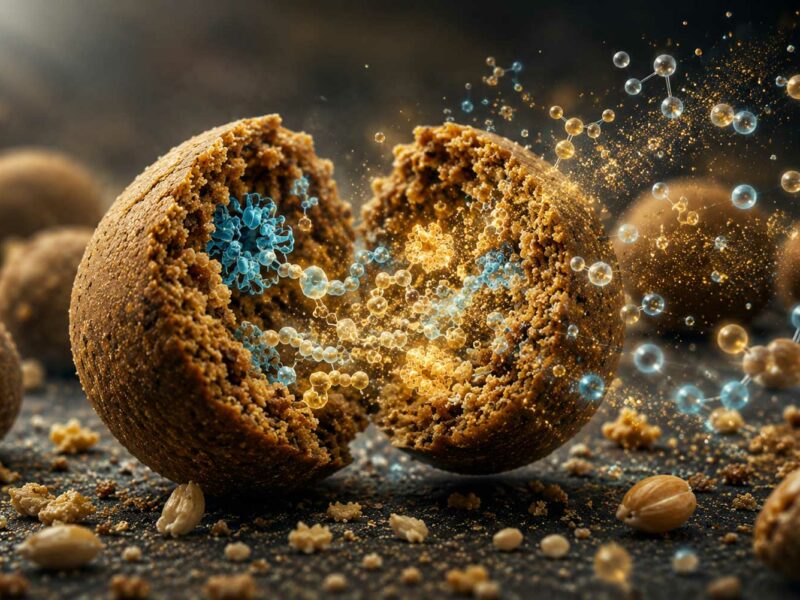
Phase 2 – the core (hours): water penetrates deeper. Protein concentrates, squid, liver extracts and GLM are released from the core. Continuously, over hours.
Phase 3 – breakdown (time): over time, enzymatic breakdown sets in. Complex compounds are split into amino acids, peptides and organic acids. Leaving the bait out there takes away the carp’s wariness and makes the bait more attractive over time.
Important note on boiling time: keep the boiling time as short as possible. Boiling washes out water-soluble attractants. On top of that comes the Maillard reaction: when overheated, amino acids can bind with carbohydrates to form insoluble compounds — measurably reducing the availability of proteins and amino acids. Attractors (betaine, amino acid powder, brewer’s yeast) are best applied after boiling as a dip or powder coating on the still-hot boilie. (Arlinghaus/Meyer 2002) Whether steaming protects the attractants better is covered in the comparison Boiling or steaming boilies.
A boilie that only binds but releases nothing – sends no feeding signals. A boilie that releases too much – falls apart. Getting the combination right is the job.
Fine or coarse boilie texture – which releases more attractants?
The basic rule: the coarser the particles in the mix, the more open the boilie texture – and the faster soluble ingredients leach out.

Coarse texture – pros: an instant attraction cloud as soon as it hits the water, oil-based ingredients leak out more easily, ideal for short sessions, essential in winter (diffusion is slow in the cold).
Coarse texture – cons: the boilie washes out faster, less suited to long periods in the water, the softer texture is more vulnerable to crayfish/bream.
Fine texture – pros: controlled, even release over hours, ideal for long-term baited spots, a harder outer skin, good enough in summer.
Fine texture – cons: slow initial effect, oils stay bound longer, less suited to short sessions.

The pro solution: a fine base meal (semolina, casein) with targeted coarse inclusions (micro pellets 2–3%, hempseed, niger seed).
Special winter rule: always mix coarser in winter. At 6°C the diffusion rate is so low that a fine boilie hardly releases any attractants. A coarse texture, a soft mix and small sizes (12–16mm) make up for the slow metabolism.
Dipping, coating, soaking boilies – the difference
Dipping – the fastest method. 10–30 minutes of intense effect.
Powder coating – dry the boilies further, wet them with liquid, roll them in a powder dip. Lasts considerably longer than dipping alone.
Soaking – leave boilies in liquid for hours or days. The method for long-term baited spots.
Coated hookbaits – wrapped hookbaits
An extra layer of powder or paste directly on the hard core of the boilie. The coating breaks down as soon as it hits the water (phase 1), then the core keeps working for hours (phase 2).
Powder coating – dry attractant powder (hydrolysate powder, amino acids, brewer’s yeast, betaine) sticks to the moist boilie. It dissolves in the water as an instant attraction cloud. No paste, no extra weight, no change to hooking.

Paste coating – soft boilie paste moulded around the hard core. A thicker layer, a longer phase-1 effect.
A bait that’s too hard can trigger mechanical receptors in the carp’s mouth: spit that out — it’s something inedible. A boilie should only be as hard as necessary. That’s why wafters and coated hookbaits often catch more than rock-hard air-dried boilies: they give a little, signal food and get kept.
The coating solves the soluble-boilie problem: the core stays stable, while the coating carries the higher share of soluble attractants. A 50/50 ratio of base mix to additives — impossible to achieve in a normal boilie. Perfect for short sessions and fishing without a baited spot.
Liquids and bait boosters – which base for which situation
Dips, liquids and bait boosters are liquid attractants for treating boilies, particles and spod mixes. The key difference isn’t the flavour but the carrier base — it decides how fast a liquid works, how deep it penetrates and whether it works at all in cold or warm water.
Oil-based – fish oils, salmon oil, hemp oil, halibut oil. Oil is lighter than water and rises — it spreads vertically through several layers of water. A visible slick forms on the surface as a visual signal. The critical problem: below 10–12°C, oil barely diffuses in water. In summer from 16°C upwards, it’s the strongest flavour carrier – the oil itself doesn’t attract, it carries the flavours and forms an oil film. Important: oils go rancid. Rancid oils put fish off.
Glycerine-based (hydrophilic base) – glycerine (E422) is fully water-miscible. Glycerine liquids mix with the water instantly. The cloud effect — as with Kiana Carp Goo (Korda Goo) — is based on glycerine: a visible cloud forms right around the bait, visual and chemical at the same time. Works equally well in cold and warm water. Can be used for anything, all year round.
Alcohol-based – synthetic flavours and classic dips. Penetrates the boilie structure extremely quickly. Evaporates quickly once it hits the water. Proven in cold water: alcohol dissolves in water regardless of temperature — where oils fail, alcohol liquids still work reliably.
Hydrolysate-based – enzymatically broken-down protein liquids: squid hydrolysate, krill hydrolysate, GLM liquid, liver liquid. The proteins are already split into peptides and free amino acids — largely water-soluble, with instant diffusion. Squid hydrolysate: low fat content, one of the best liquids for cold water. The most reliable base for winter and spring.
An often overlooked biochemical fact: carp can only smell water-soluble compounds. Oil itself is insoluble in water — the carp doesn’t smell the oil, it smells the water-soluble flavour compounds and breakdown products that the oil carries and slowly releases. That’s another argument for natural hydrolysates and extracts. (Arlinghaus/Meyer 2002)
| Base | Cold below 12°C | Warm above 16°C |
|---|---|---|
| Oil | ✗ barely effective | ✓✓ ideal |
| Glycerine/water | ✓✓ ideal | ✓✓ ideal |
| Alcohol | ✓ good | ✓ good |
| Hydrolysate | ✓✓ best choice | ✓✓ ideal |
Poor-quality boilies can’t be rescued by any liquid. A liquid is a booster — not the foundation. You’ll find liquids and bait boosters at almost every boilie exhibitor at Carp Austria. Kiana Carp Goo (Korda Goo), the dip and cloud specialist, presents its full range at the GOO Bar on the Korda stand.
Combining boilies with pellets
Pellets and boilies aren’t rivals – they complement each other perfectly. Pellets in different sizes (3mm, 8mm, 20mm) create a staggered timetable: 3mm pellets break down within minutes, 20mm pellets keep working for hours. The baited spot stays active all day without constant topping up.
Carp know pellets from being reared on fish farms – they react instinctively to the smell. Halibut pellets are particularly rich in oil and protein. Important: use fresh pellets – rancid pellets put fish off instead of drawing them in. Which pellets work when is covered in the guide Carp pellets.
Micro pellets (2–3%) can be rolled straight into the boilie mix. Underwater they come loose from the boilie and open up the structure for faster release of attractants.
The crunch effect – acoustic signals underwater
In nature, carp crush hard food: mussels, snails, nuts. The cracking sound travels a long way through the water and gets other carp feeding. You can build this effect into a boilie:
- Tiger nuts in the bait – automatic crunch
- Crushed eggshells in the boilie mix – Lee Jackson and Nick Helleur use this English pro method. 2–4mm eggshell fragments → the boilie cracks audibly when crushed
- Hard pellets in the bait mix
- Hard maize as a particle
Protection against bream, crayfish and gobies
Against bream: go up to 25mm, a hard casein coating, air-dried boilies (rock-hard from air-drying).
Against crayfish (signal crayfish, spiny-cheek crayfish): air-dried boilies, 25–30mm, fake corn/plastic baits as hookbaits, pop-ups or a zig rig. Given time, crayfish can nibble away at hard boilies too.
Against gobies (Donau/Danube, March): a 25mm+ air-dried boilie or pop-up as hookbait – the only reliable solution.
Bait protector – a fine shrink mesh over the hookbait, shrunk with steam. Protects against crayfish, bullhead catfish and gobies. Carp still pick up the bait without any problem.

Sweet or fishy – when to use which?
Sweet: water temp. above 15°C → early summer, summer, early autumn. Fruity flavours, NHDC, vanilla, caramel. Carp need a lot of energy and look for carbohydrates.
Fishy: falling water temp. (approx. 15–8°C) → autumn. Fishmeal, krill, belachan, liver extract. In winter, deliver fish flavour through easily soluble hydrolysates rather than heavy fishmeal. Carp look for protein-rich food to build up fat reserves.
Exceptions: on heavily fished waters where everyone is fishing fishy boilies → sweet boilies as a contrast bait. Always: know your water and adapt.
Freezer, preserved, salted – which is better?
Freezer baits – frozen, with no preservatives. The freshest quality, all attractants fully intact. As soon as they thaw, breakdown starts. Downside: they need a cold chain and have a limited life once thawed (2–5 days).
Salted – salt draws out moisture and prevents mould without preservatives. The boilies go very hard (an advantage against crayfish/bream). Shelf life: 12+ months. The salt is both preservative and attractant.
Chemically preserved – shelf life: 12–24 months. Downside: preservatives slow down breakdown and can measurably reduce catch rates.
Alcohol-preserved – instead of chemical preservatives, a special alcohol compound. The alcohol evaporates as soon as it hits the water — no preserving compounds stay in the bait. Behaves in the water like a freezer bait. Shelf life up to 12 months without refrigeration. MM Baitservice uses this method consistently — as a deliberate decision against all standard preservatives.
Bottom line: long-term baited spots → freezer baits are the best option. Spur-of-the-moment sessions and travel → salted or alcohol-preserved. Chemically preserved only if none of the other options is available.
Why salt and sugar in boilies are always a good thing
Salt does three jobs: (1) preservation through osmotic pressure; (2) hardening by drawing out moisture; (3) attractant — sodium directly stimulates the feeding reflex, and carp can detect the ion concentration through their chemoreceptors.
Sugar is just as versatile: (1) preservation; (2) attractant — carp react strongly to sweet stimuli; (3) a fermentation starter; (4) complementary to salt — sweet and salty is one of the strongest taste combinations.
For homemade recipes: 3–5% salt in the boilie mix as standard. For salting on the outside: approx. 250g salt per kg of finished boilies. NHDC instead of large amounts of sugar — up to 1,800× sweeter than sugar, so a tiny dose is enough.
Boosting boilies – a quick way to more pulling power
Soaking: dry the boilies further, then soak them in liquid. Dry boilies soak the liquid up deep inside.
Needling: push a baiting needle through the hookbait. Water gets in faster, attractants get out faster.
Halving/quartering: the cut face releases attractants instantly – for short sessions without a baited spot.
PVA stick: pack stick mix around the hookbait. It dissolves straight away and creates a concentrated attraction cloud right by the hookbait.
Sweetcorn juice as a boilie booster – the juice from the tin is an underrated free dip. It naturally contains sucrose, fructose and natural glutamate plus salt. Soak boilies briefly in the corn juice: an instant sweet and salty attraction cloud that carp from pond farms know as familiar food. Costs nothing, works straight away.
Amounts of bait – size of water and strategy decide
When to bait and how much? There’s no universal answer. It’s nature, individual approach and experience — but there are clear principles.
Whatever is in the water can’t be taken back out. Better to bait too little and step it up than too much – an overbaited spot works against you.
Small amounts on big waters over 10 ha achieve next to nothing — unless a target carp has already been confirmed there and you know exactly where it’s holding. The bait spreads out, the fish spread out, the effect fizzles out. On small waters up to 10 ha, moderate baiting works reliably and always pays off.
The Frank Schmidt method – large baited areas for big lakes
The other philosophy — and one of the most successful of all — is embodied by German carp fishing legend Frank Schmidt. He is one of the anglers with the most carp over 30 kg to his name. Schmidt is a firm believer in heavy baiting over large areas — and his results speak for themselves.
The method: from the very first day of fishing, huge baited areas are laid down. Baiting is done exclusively with highly digestible boilies from his own production — here the eat–digest–come back principle isn’t a by-product but the deliberate strategy. The carp don’t get full — they’re drawn to these baited areas and held there.
Once the first fish reach the baited area, they don’t leave it again — because it’s topped up every day. Every day the chance of catching a big carp goes up. The method works especially well if you have at least a week — better two to three weeks — and are prepared to put in 200 to 500 kg of top-quality feed boilies.
This strategy can mean that within two to three weeks the entire stock of big fish in a large pond or smaller lake is systematically drawn into the baited area and caught there.
That sounds like a lot. For one or more carp over 30 kg, it isn’t.
Hookbaits: anything can work. Single hookbait, snowman, half ‘n’ half, pop-up, zig. Find out what works on your water – not on someone else’s.
Buy ready-made, roll your own or use a rolling service?
Buy ready-made – ready to use straight away, proven, tested on the bank. What to look for when buying is explained in the guide Buying boilies.
Roll your own – your own recipe, nobody else on the lake is fishing the same bait, and you get a deeper understanding of your bait. Basic recipe: fishmeal (50%), birdfood (25%), semolina (25%), eggs, flavour. If you roll larger quantities regularly, a boilie rolling machine saves you a lot of time.
Boilie rolling service – the best compromise. Have your own recipe rolled by a professional bait company. Baitservice Straubing, MM Baitservice, Carp’s Kitchen and Baitservice Austria are all at Carp Austria.
Durum wheat semolina vs. soft wheat semolina
Durum wheat semolina makes the boilie harder and improves binding — ideal for feed boilies that need to stand up to nuisance fish. Soft wheat semolina makes the core of the boilie softer and lets added flavours leach out more easily — better for hookbaits that should release attractants straight away.
Boilies live – the best bait companies at Carp Austria
Smelling boilies, feeling them, talking directly to the people who make them – you can only do that at the show. At Carp Austria you’ll find Austria’s biggest selection of boilies:

Many companies bring freshly made, show-exclusive boilie flavours – flavours you won’t find anywhere else. Get your tickets for Carp Austria.
You’ll find the complete, continuously updated list of companies in the boilie companies overview. Without the right bait, even the best landing net is no use – you’ll find the carp landing net guide here.
The most legendary ingredients in boilie history

Robin Red (Haiths) – a bird food conditioner from the 1970s, in every pro recipe ever since. Spicy and hot, intense red colour, natural composition. Works just as well in birdfood mixes as in fishmeal mixes.
Scopex (Rod Hutchinson) – a buttery caramel flavour, one of the first chemical boilie attractants. The Scopex Squid concept shaped modern boilie fishing. Works in cold and warm water alike.
Betaine (glycine betaine = N-trimethylglycine) – the most misunderstood active ingredient on the carp scene. Only glycine betaine with the structural formula (CH₃)₃N-CH₂COOH is effective — no other betaine. Other betaines (ornithine betaine, histidine betaine) have been shown to be ineffective for carp.
As a student, Robert Arlinghaus researched the scientific literature on attractors for carp and passed the information on to Jürgen Meyer of M+M Baits — who in 1998/1999 became the first German dealer to offer genuine glycine betaine. An article published at the time contained a typo in the structural formula — anglers who then tried to order the original product got nowhere.
Important: on its own, betaine is ineffective at concentrations of 10⁻⁸ to 10⁻¹³ mol/l. It has its strongest effect as a sensitiser: at 0.001 molar it lowers the stimulus threshold for L-alanine and other amino acids — the carp tastes other attractants more intensely. Best effect: glycine betaine + amino acid blend + sodium L-aspartate combined. Natural sources: sugar beet, molasses, barley, mussels, worms, liver meal. Effective all year round, especially at low temperatures. (Arlinghaus/Meyer 2002)
CSL (corn steep liquor) – the cheapest instant attractant. Sweet and fermented, rich in amino acids, an instant attraction cloud.
N-butyric acid – rancid, cheesy, putrid. Forms naturally during fermentation. Carp can’t resist it. Combined with strawberry, one of the most classic blends.
GLM (green-lipped mussel) – marine pulling power based on real natural proteins. Contains natural betaine. Carp recognise it as real food.
Belachan – fermented shrimp, free amino acids, clings to the bait underwater for a long time. An instant attractor even without a baited spot.
Beef liver extract – 100% water-soluble, releases betaine instantly. Beef liver is the best type of liver for boilies.
Bloodworm / Chironomidae – chironomid larvae as the most natural carp signal there is. Hard to beat on silty waters with a natural bloodworm population.
Hemp – a nutty smell of its own, omega fatty acids, mucilage that aids digestion. Carp that have eaten hemp once will actively look for it.
Tiger nut – an unbeatable crunch effect, sweet and nutty, crayfish-proof. One of the most reliable particle baits on the scene – for decades.
DMPT – a sulphur-containing marine compound from aquaculture research. The fastest attractant dispersal in water.
Krill ester blend – phospholipid-bound omega-3 fatty acids, 10× faster to dissolve in water than triglycerides.
Talin vs. NHDC – the two worlds of boilie sweeteners
NHDC – neohesperidin dihydrochalcone — semi-synthetic, made from neohesperidin or naringin (flavonoids from bitter orange and grapefruit). 250 to 1,800 times sweeter than sugar. Delayed onset of sweetness after 1–2 seconds. A slightly bitter note when overdosed. Inclusion rate: 0.005–0.05% of the mix.
Talin – thaumatin (E957) — a natural protein from the West African plant Thaumatococcus daniellii. 2,000–3,000 times sweeter than sugar. Instant sweetness, no bitter note. As a natural protein, thaumatin has a dual biochemical function: sweetener + amino acid source.
| NHDC | Talin | |
|---|---|---|
| Sweetness vs. sugar | 250–1,800× | 2,000–3,000× |
| Origin | Semi-synthetic from citrus | Natural plant protein |
| Bitter note | Yes, when overdosed | No |
| Onset of sweetness | Delayed | Instant |
| Extra function | Pure sweetener | Protein + amino acids |
What experienced bait makers recommend: combine both — NHDC delivers the lasting sweetness, Talin the instant hit of sweetness plus a natural protein content.
Enzymes in boilies – a quick overview
No term is used more often right now – or less precisely – than enzymes. The phrase “enzymes in the boilie” tells you very little unless it says which enzymes, for what purpose and under what conditions.
Proteases – split proteins into peptides and free amino acids. Natural sources: papain (papaya), bromelain (pineapple).
Amylases – split starch into simple sugars. Starch is insoluble in water → no pulling power. Sugars split off by amylase → instantly water-soluble.
Lipases – split fats into fatty acids and glycerol. Free fatty acids and phospholipids disperse better in water than pure oil – one reason why krill ester blend is considered more effective than normal krill oil.
The critical point: boiling destroys enzymes. By 100°C at the latest, all enzymes are denatured — most of them from around 60–70°C. On top of that comes the Maillard reaction: when overheated, amino acids bind with carbohydrates to form insoluble compounds — measurably reducing the availability of attractants. The consequence: active enzymes and heat-sensitive attractors go onto the boilie after boiling. Always keep the boiling time as short as possible. (Arlinghaus/Meyer 2002)
Pre-digested fishmeal is the best-known enzyme product in the fishing industry: proteases split fishmeal proteins into peptides and amino acids — instantly water-soluble and directly detectable via chemoreceptors. Enzyme soaks, temperatures and hydrolysates are explained in detail in the article Enzymes in boilies.
Boilies for catfish – what attracts wels catfish?
Catfish and carp share the same waters — but they react very differently to baits.
Ingredients that attract catfish: N-butyric acid (the strongest catfish signal), blood meal/blood extract, beef liver extract, belachan, DMPT, overripe fermented fruit.
Boilie strategy for catfish: 25–40mm minimum. Softer boilies or semi-rolled paste. On rivers, put the bait in the deepest spot. More active at night than during the day.
If you DON’T want catfish: cut back on marine flavours. Plant-based fruit flavours instead of meat/blood/liver. Hard air-dried boilies.
Note: on the Donau (Danube), Drau, March and Mur, catfish by-catch is almost unavoidable. Always have a suitable carp landing net with you.
The science behind attractants – attractant, stimulant, palatant
Most anglers only know the word “attractant”. Science and good bait companies make finer distinctions (covered in detail in the guide Boilie attractants):
Attractant – long-range attraction: water-soluble compounds that leach from the bait into the water and form a chemical trail. GLM, krill hydrolysate, squid, fish oils, CSL.
Stimulant – feeding trigger: amino acids and betaine. They act on specific receptors in the carp’s mouth — and trigger the feeding reflex directly. Scientifically confirmed. Betaine is the best-known single feeding stimulant.
Palatant – taste appeal: extracts from the carp’s natural food — worms, mussels, crayfish, liver, squid. They make the boilie acceptable in the mouth: the carp keeps it instead of spitting it out. Unlike synthetic flavours, natural extracts can’t be linked with bad taste experiences — the carp knows this taste as safe food.
Enhancer / natural enhancer – amplifier: synergistic compounds that make all the other components more intense.
Sweetener – NHDC and Talin (see separate section).
Colourant – standard boilie colours for contrast. Fluoro colours (UV-reactive) for poor visibility and deep water.
Ingredient – basic ingredients: binders, structure builders, protein sources, oils.
The attractant hierarchy – what really works
According to Robert Arlinghaus (2002) — based on a review of the scientific literature — the following substances work as attractors for carp, in descending order:
- Natural extracts from invertebrates and fish — crayfish, worms, mussels, fish. Extracts from worms and crayfish outperform mussel and fish extracts.
- Ingredients with a high share of free amino acids — liver meal, fish and meat meal, milk proteins, blood meal, brewer’s yeast.
- Synthetic amino acid blends with glycine betaine — better than single amino acids.
- Single amino acids — L-proline (the most effective), glycine betaine, peptides, water-soluble proteins.
- Natural substances — spices, essential oils, sugar compounds, salts.
No effect as an attractor: enzymes, lecithin, oil/fat — purely nutritional function.
Repellent effect: bitter substances, strong acids and bases. Preservative acids in shelf-life boilies don’t just inhibit bacteria – they also reduce attractiveness.
The catch model in three sentences: the attractant brings the carp to the bait. The stimulant triggers feeding. The palatant stops it spitting the bait out. The enhancer maximises all three.
Protein content in boilies – what the number on the bag really means
The biochemical sweet spot is approx. 40% crude protein — any protein beyond that is burned for energy. Carbohydrate boilies are digested faster — the carp comes back sooner (eat–digest–come back).
Protein quality – NEB value: redfish meal: 96–97% digestibility. Standard LT fishmeals: 92–93%. Plant proteins (soya): considerably lower. HT fishmeals have reduced bioavailability because of the harsh production process.
Seasonal protein strategy: spring 8–16°C → 25–35%, easily digestible (milk protein, calf milk replacer, hydrolysates). Summer above 16°C → 25–35%, carbohydrate-led – there’s plenty of natural food, and too much protein puts a strain on the fish in warm water with little oxygen. Autumn (falling from 20 to 8°C) → 40–50%, fishmeal and krill for intensive baiting campaigns. Winter below 8°C → 25–35%, highly digestible, hardly any oil, only small amounts. Digestibility matters more than the percentage.
The ammonia problem – why too much protein ruins catch rates
When protein is digested for energy, ammonia is produced as a waste product — a potent cell toxin. It is excreted mainly through the gills. Unfavourable environmental conditions — low oxygen levels, high water temperature — can make it harder to excrete. That may explain why higher protein levels in the bait cause catch rates to tail off after a while.
In practice: during intensive HNV campaigns, switch to a carbohydrate mix regularly. In high summer, cut HNV quantities drastically.
Brewer’s yeast and brewer’s yeast extract (Brocacell) – the forgotten powerhouse
Brocacell turns up in almost every professional boilie mix. Hardly any guide explains why.
Brocacell is made from inactive yeast cultures of Saccharomyces cerevisiae. The cell walls are broken open — making the cell contents up to 90% water-soluble. The result: over 50% protein, a complete essential amino acid profile and a high B vitamin content.
Dual function: as an attractant: free amino acids (L-valine, L-arginine, L-lysine, L-proline, glutamic acid) diffuse into the water instantly. As an enhancer: glutamic acid creates an umami taste that intensifies all the other taste components.
The pro trick: after boiling, sprinkle brewer’s yeast over the still-hot boilies and give them a shake. The powder sticks to the moist surface — an instant attraction cloud without a soak or dip. Inclusion rate in the mix: 3–10%.
Specific amino acids – what science really knows
From scientific carp research, evaluated by Robert Arlinghaus:
Russian researchers: cysteine, asparagine, glutamic acid, threonine and alanine as stimulants (L-form). Japanese researchers at 0.001 to 10⁻⁹ molar: L-proline (the most effective as a taste), L-alanine, L-cysteine, L-glutamic acid, L-glycine. Olfactory stimulus threshold: 10⁻⁶ to 10⁻⁹ molar.
The key finding: amino acids often only work in combination. The right combination — as in natural extracts (GLM, krill, liver, worm extract) — is stronger than the sum of its parts. That’s the scientific proof of why palatants from natural extracts work better than synthetic single amino acids.
Water temperature – the most important factor for digestion and feeding behaviour
Carp are cold-blooded. No other factor affects how well boilies work more than water temperature.
Oxygen levels – the second underestimated factor
At 20°C a maximum of ~9.1 mg/L of oxygen dissolves in water. At 30°C, only ~7.6 mg/L. The biochemical dilemma of high summer: the warmer the water, the more oxygen the carp needs — and the less the water can hold.
| Situation | O₂ | Boilie strategy |
|---|---|---|
| Spring/autumn, windy | High | Bait normally, all types |
| High summer, no wind, shallow lake | Low | Bait minimally, O₂-rich spots |
| After a thunderstorm/heavy rain | High | Bait heavily |
| Just before sunrise | Daily low | Choose O₂-rich areas |
| South-westerly storm | Rising | Best summer conditions |
Oxygen swings in high summer – the weed trap
In weedy waters, high summer brings extreme swings in oxygen within 24 hours. During the day, in sunshine, the plants produce huge amounts of oxygen through photosynthesis — levels can climb to 12–15 mg/L, well above the saturation optimum. For carp, that means stress from supersaturation. At night the process reverses: the plants consume oxygen through respiration without producing any more — the O₂ curve falls steadily.
Just before dawn, oxygen levels hit their daily low. In heavily weeded waters, critical levels below 4 mg/L are possible — carp actively head for the surface or stop feeding altogether. That’s the moment when many anglers blank in frustration, even though there are carp in the lake and they’re even showing at the surface.
Very dull days are the most dangerous situation in summer. Without light, the plants can barely photosynthesise during the day. The O₂ level stays low all day — and the plants start drawing oxygen out of the water earlier than usual, because by the afternoon photosynthesis can no longer make up for their own respiration. The result is a permanently low-oxygen state over 24 hours. For carp that means extreme stress, hardly any feeding and, if it goes on, possible damage to their health. Dull, overcast days in high summer are among the worst fishing days of the year — not because of the carp, but because of the water.
What to do when oxygen is low: choose spots with flow, inflows or wind-facing areas. Don’t bait heavily — weakened carp can hardly process protein-rich boilies. Easily digestible carbohydrate boilies instead of HNV. Early morning is the critical period — better to wait until oxygen rises again after sunrise.
Stick mix, spod mix and PVA – presenting boilies properly
PVA bag: a bag made of polyvinyl alcohol that dissolves completely in water. Ideal for winter, new spots and short sessions. Everything has to be dry.
PVA stick / PVA mesh: a tube of PVA mesh. More compact, more precise. Filled with fine stick mix.
Spodding: accurate baiting at long range (60–100m+) without a bait boat. Essential for long-term baited spots and the Frank Schmidt method.
The basic rule: PVA for instant presentation without a baited spot. Spod for quantity and distance with a baited spot.
Angling pressure and learning – why carp get wary
Carp learn. On heavily fished waters, certain flavours, colours and types of bait become associated with bad experiences.
After a while the bites on a baited spot tail off — even though there are carp on the spot. As soon as just the flavour is changed, the boilie catches again for a while. With high-quality boilies with a complete nutritional profile, this effect is much less common.
Hook avoidance – scientifically proven
Klefoth & Arlinghaus (2013, Fisheries Management and Ecology) studied the hook avoidance behaviour of carp under controlled conditions:
Carp learn to recognise the hook VISUALLY. In the lab, after just a few days of fishing, carp could be caught almost only at night — exactly when they could no longer see the hook. Carp don’t just learn from their own experience but also by watching other fish (social learning).
The fish kept visiting the baited spot — but picked up the hook less and less often, or spat it out straight away. So few bites doesn’t automatically mean there are no carp on the spot.
Carp can retain hook avoidance for over a year.
Night fishing under angling pressure: scientifically proven — as angling pressure increases, carp become more and more nocturnal.
Mirror carp vs. common carp – which is easier to catch?
Klefoth & Arlinghaus (2013): mirror carp are much easier to catch — 55% of the mirror carp in ponds were caught vs. only 32% of the commons. In the lab, 85% vs. 55%. The reason: mirror carp are more active and feed faster and more boldly — a result of centuries of breeding for fast growth.
In COLD water the ratio is reversed — commons stay more active in the cold. On waters with lots of commons, winter and early spring offer better chances.
45–68% of the carp in the study were never caught — regardless of the bait, regardless of the technique. Not every blank is the bait’s fault.
What helps: natural palatants (worms, mussels, crayfish) can’t be linked with angling pressure. Washed-out colours under heavy angling pressure. A single hookbait without a baited spot. Unusual flavours (asafoetida, swan mussel).
Overstocked waters – commercial fisheries
On heavily overstocked waters where food is scarce, boilie quality has hardly any influence on catches — the carp eat whatever is available. On normal waters, the carp decide for themselves — and choose by quality.
Snailgrub Force from Baitservice Austria

The snailer shape imitates a water snail — a natural food source that carp know and eat all their lives without ever having a bad experience with it. No conditioned aversion, no suspicion. Snail meal, GLM and insect meal — all three are genuine palatants, can’t be conditioned and don’t wear out.
Bait signature (“Bait DNA”) – the chemical recognition profile of a boilie
A bait signature is the unique biochemical fingerprint of a boilie. When carp eat the same boilie for weeks and months without a bad experience, they associate its chemical profile with safe food.
In practice: if you’re planning a long-term baiting campaign, pick one boilie and stick with it. Consistency beats variety.
Emulsifiers – why oil and water are a problem in a boilie
Oil and water don’t mix. Without an emulsifier, oil-soluble and water-soluble ingredients are spread unevenly through the paste. Lecithin is the most important natural emulsifier — it’s found in fresh egg yolk. That explains why fresh eggs work so much better than egg powder. Soya flour contains natural lecithin and is a cheap source of emulsifier in the mix.
Asafoetida – the underrated classic of the carp scene
Asafoetida (also known as hing) is a dried gum resin from the roots of Ferula assa-foetida. It contains intense sulphur compounds — disulphides and polysulphides — that resemble naturally decaying organic matter. For a carp searching the sediment for food signals, that’s a familiar smell pattern. Important: use genuine natural resin extract — synthetic imitations are much weaker. Also attracts catfish.
Why high-quality boilies are worth the money
The price of a boilie directly reflects what’s in it. A boilie costing a few euros per kilo usually consists of semolina, binder, colourant and a flavour that smells good to the buyer. No attractant, no stimulant, no palatant. Just smell. How to spot quality before you buy is explained in the guide what to look for when buying boilies.
The most common baiting mistake
Cheap feed boilies, expensive hookbait. Cheap feed boilies will draw carp to the spot in the short term. But a long-term baited spot only works if the carp find real value there and feed actively. Feed boilies and hookbaits should come from the same mix or share the same biochemical signal profile. What really belongs in a feed boilie is covered in the feed boilies guide.
Location and timing are the most important ingredients
Everything in this guide is worthless if the hookbait is on the wrong spot or in the water at the wrong time. An average boilie in the right place at the right time beats the perfect boilie in the wrong place every day of the week.
The best ingredient is confidence in your own bait.
Location and timing are the most important ingredients. The boilie comes after that.
Scientific sources
Karl von Frisch (1913) — Nobel laureate, showed that cyprinid fish (Cyprinidae) have highly developed colour vision. The oldest scientific source on colour vision in carp.
Whitmore & Bowmaker (1989) — demonstrated UV cones in cyprinids using microspectrophotometry. The scientific basis for their tetrachromat status. 4 cone types: UV (~360nm), blue (~450nm), green (~530nm), red (~620nm).
Neumeyer (1992) — “Tetrachromatic color vision in goldfish: evidence from color mixture experiments” — confirms tetrachromatic colour vision through behavioural experiments.
Arlinghaus, R. & Meyer, J. (1999) — “Boilies Hausgemacht” (Homemade Boilies), a foundational work on digestion, ingredients, attractant effects and dairy products in the boilie mix. Robert Arlinghaus, then a student, is now a professor at Humboldt-Universität zu Berlin and one of Europe’s leading fisheries ecologists (IFishMan project).
Arlinghaus, R. & Meyer, J. (2002) — “Wieso, Weshalb, Warum – Teil 3” (Why, How, What For – Part 3), a scientific analysis of attractors, amino acids, betaine, flavour biochemistry and the attractant hierarchy in carp.
Arlinghaus, R. & Meyer, J. (2001) — “Wieso, Weshalb, Warum – Teil 4” (Why, How, What For – Part 4). Five factors for feeding in carp, incl. satiation as the decisive 5th factor.
Klefoth, T. & Arlinghaus, R. (2013) — “Hakvermeidung von Schuppen- und Spiegelkarpfen wissenschaftlich untersucht” (hook avoidance in common and mirror carp, scientifically studied), Klefoth, T.; Pieterek, T.; Arlinghaus, R. (2013). “Impacts of domestication on angling vulnerability of common carp, Cyprinus carpio.” Fisheries Management and Ecology, 20: 174–186. Leibniz Institute of Freshwater Ecology and Inland Fisheries Berlin + Humboldt-Universität zu Berlin.