Boilies: boiling or steaming – which method is better for carp baits?
Steaming boilies is the better method when valuable water-soluble attractors should remain inside the bait. During boiling, betaine, free amino acids, GLM extract, liver extract, soluble peptides and water-soluble vitamins can partly move into the cooking water. When boilies are steamed, the bait is not sitting directly in water. This reduces wash-out and helps sensitive ingredients stay inside the boilie. Boiling still makes sense for simple base mixes, large feeding quantities and fast production. Steaming is more useful for premium boilies, hookbaits, pop-ups and boilies made with expensive extracts.
Steaming: slower, but stronger for water-soluble ingredients – no direct water contact, less wash-out and better control for premium hookbaits.
Practical rule: Simple feeding boilie = boil it. Expensive premium boilie with GLM, betaine, amino acids, hydrolysates or liver extract = steam it.
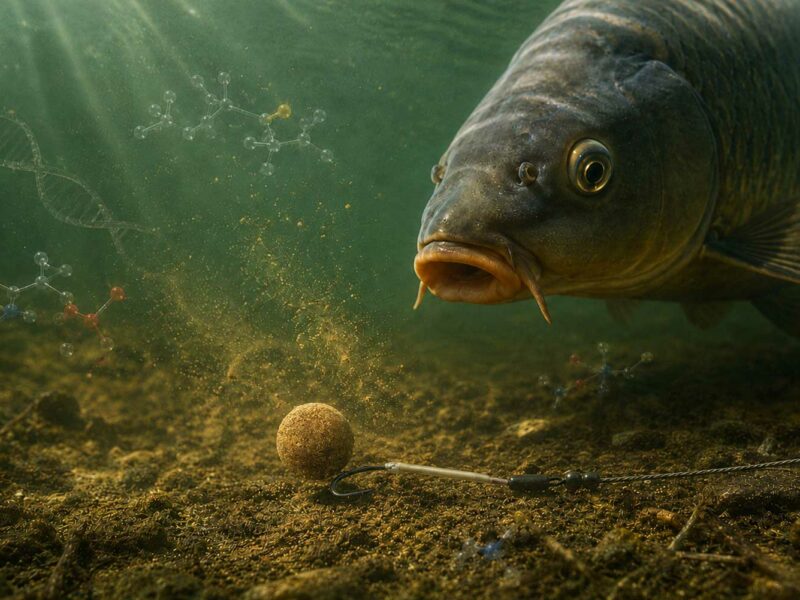
You put expensive ingredients into your boilie dough — GLM extract, betaine, free amino acids, liver extract. Then you boil the boilies for 90 seconds to a few minutes in hot water. What happens is simple: part of these water-soluble attractors dissolves into the cooking water and does not remain completely inside the bait. The cooking water smells excellent — because it contains exactly the substances that should actually work inside the boilie.
Steaming reduces this problem significantly. No direct water contact, much less wash-out. The boilie retains sensitive water-soluble ingredients better inside the bait. That is the core difference — and one important reason why many professional bait producers use steaming for premium hookbaits, pop-ups and expensive extract-based mixes.
What happens when boilies are boiled – the process
When boilies are boiled, the rolled baits are placed in boiling water for around 90 seconds to 3 minutes. The exact time depends on boilie size, recipe, egg content, meals, binders and the desired hardness. The heat denatures the proteins in the dough. Egg protein, fishmeal proteins and plant proteins coagulate, form a firm matrix and turn the soft dough into a stable carp bait.
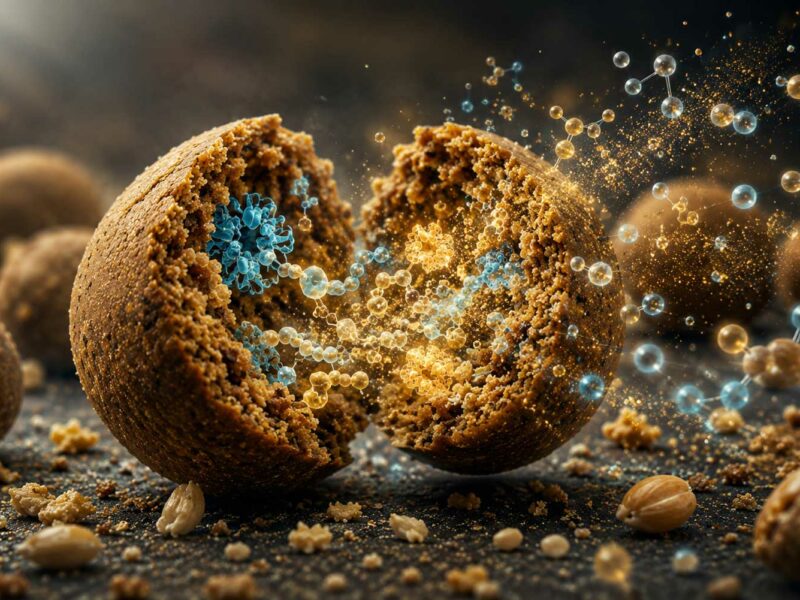
At the same time, the main problem occurs: water is a strong solvent. Free amino acids, betaine, extracts, water-soluble vitamins and soluble peptides can pass through the surface before it is fully sealed and move into the cooking water. The more water-soluble ingredients a mix contains, the more important this becomes. Over time, the cooking water itself turns into an attractor extract — clear evidence that active compounds have left the bait.
Important exception: betaine is thermostable
Betaine is not destroyed by heat during boiling. Betaine, chemically N-trimethylglycine, is thermostable at boiling temperatures of around 100 °C. The zwitterionic structure remains intact at this temperature. If betaine is lost during boiling, this is not due to thermal degradation, but due to water solubility and diffusion into the cooking water.
That is an important difference: betaine in the cooking water is lost betaine — but not burned or destroyed betaine. During steaming, betaine is retained better in the boilie because there is no direct water contact. For high-quality mixes with betaine anhydrous, steaming is therefore especially interesting: the effect is not better retained because of lower temperature, but because less betaine is washed out.
In practice, this means: if you use betaine in boilies, you do not need to fear 100 °C heat. What matters is whether the boilie is sitting in water or only being cooked in steam. During boiling, betaine can move from the boilie into the water. During steaming, it remains better inside the bait.
What happens when boilies are steamed – the gentler route for water-soluble ingredients
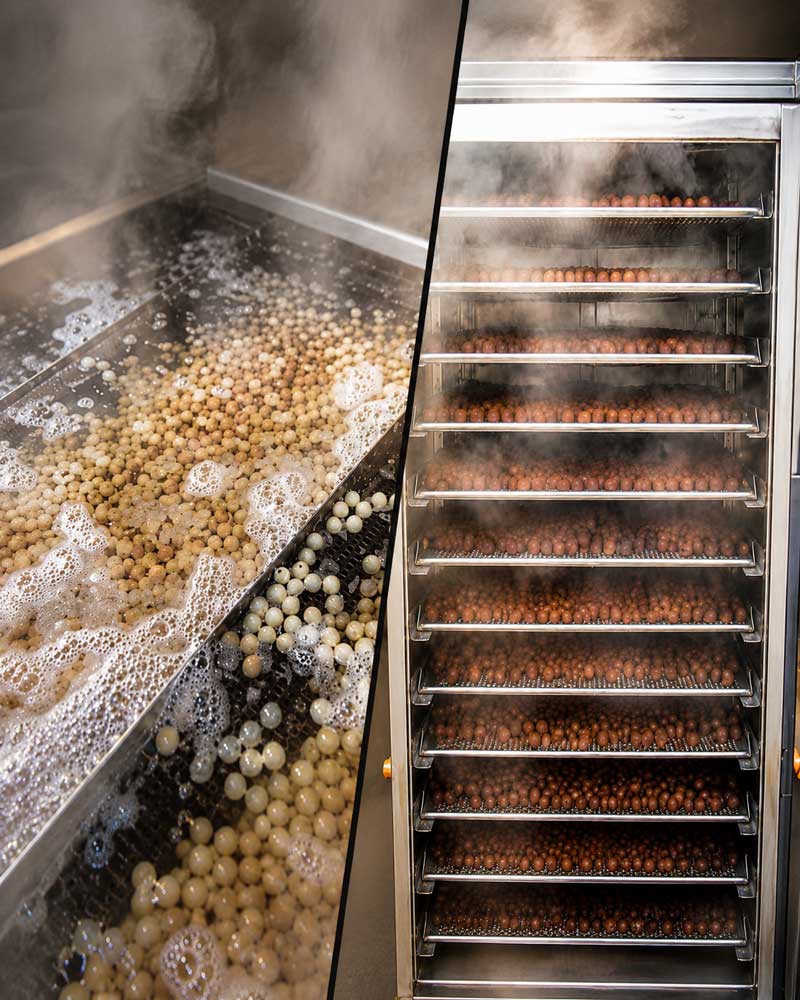
When boilies are steamed, they are not cooked in water but in hot steam. Depending on the equipment, the temperature is similar to boiling, but the key difference is the lack of direct water contact. The boilie sits in steam, not in water. Water-soluble substances therefore have no direct route into the cooking water.
The principle is similar to steaming vegetables: water-soluble compounds are retained better because they are not washed out into cooking water. Applied to boilies, this means that betaine, free amino acids, GLM extract, liver extract, hydrolysates and soluble peptides tend to remain better inside the bait.
The disadvantage: steaming takes longer. Small boilies may be ready after around 8–10 minutes, while larger or denser boilies often need 10–17 minutes. It also requires equipment: a steamer, preserving cooker, steam insert or, in professional production, a combi steamer.
Direct comparison – what is really different?
| Criterion | Boiling | Steaming |
|---|---|---|
| Attractor loss | Higher — water-soluble substances can move into the cooking water | Significantly lower — no direct water contact |
| Betaine | Thermostable, but water-soluble — loss occurs through leaching, not heat degradation | Retained better in the boilie because there is no direct water contact |
| Protein denaturation | Short and intense — with short boiling times, often less total heat exposure | Gentler medium, but longer exposure — time × temperature decides |
| Outer skin | Usually harder and denser because of direct water contact | Often slightly softer and more porous — good, even attractor release is possible |
| Enzymes | Deactivated by heat | Also deactivated — no real advantage |
| Time | Approx. 90 sec. – 3 min. depending on size and mix |
Approx. 8 – 17 min. depending on size, mix and equipment |
| Equipment | A cooking pot is enough | Steamer, preserving cooker or combi steamer required |
| Maillard reaction | No relevant Maillard reaction at 100 °C | No relevant Maillard reaction at 100 °C |
| Best suited to | Simple base mixes · mass production · freezer baits · large feeding quantities | Expensive ingredients · premium hookbaits · pop-ups · professional production |
Protein denaturation – why shorter boiling can be gentler on proteins than long steaming
Both production methods denature proteins. This is unavoidable and also desired: only through denaturation do egg protein and meals lose their raw structure and form a firm boilie structure. The question is not whether proteins denature, but how much.
Protein denaturation is a function of temperature × time. Both methods work with high heat. With boiling, the exposure time is much shorter; with steaming, the medium is gentler, but the cooking time is longer. That is why the simple statement “steaming is always gentler” is too broad.
| Method | Temperature × time | Practical assessment |
|---|---|---|
| Boiling | 100 °C × approx. 90 sec. – 3 min. depending on size and mix |
Short heat exposure — can be better for some proteins |
| Steaming | 100 °C × approx. 8 – 17 min. depending on size, mix and equipment |
No wash-out, but longer heat exposure |
Important: boiling and steaming times are guidelines. They can vary considerably depending on boilie size and ingredients. A 15 mm fishmeal boilie behaves differently from a 20 mm pop-up with maize content or algae powder. Test batches are the most reliable method.
A frequently cited food technology study compared boiling and steaming at the same duration. Under equal time conditions, steaming can be structurally gentler because steam is a less leaching medium than water. In real boilie production, however, the times are often not equal. In that case, the shorter boiling time can be less stressful for certain proteins than a much longer steaming process.
A practical example: with a GLM boilie containing spirulina algae powder, longer steaming can change the green colour more strongly than short boiling. The green pigment phycocyanin is itself protein-based and reacts sensitively to longer heat exposure. The conclusion: steaming protects water-soluble attractors better, but shorter boiling can be gentler on certain protein or pigment structures.
Enzymes do not reliably survive boiling or steaming
A common misconception is that steaming automatically preserves enzymes better than boiling. Enzymes such as protease, amylase or lipase are heat-sensitive and are often deactivated in the range of roughly 40–60 °C. Boiling and steaming both go clearly beyond that. Active enzymes therefore do not reliably survive either method.
Anyone who wants active enzymes in the finished boilie has only one safe option: apply enzymes after boiling or steaming, once the boilies have cooled down — for example as an enzyme soak or enzyme dip. They can then penetrate the surface and become active in the water.
Another approach is enzymatic pre-treatment of the dough. In this case, proteins are broken down before cooking, releasing free amino acids. The enzymes themselves are later deactivated by heat, but the released building blocks remain in the boilie. This is the key difference between active enzymes in the final bait and an enzymatically prepared recipe.
Maillard reaction – why it hardly matters for boiled and steamed boilies
The Maillard reaction is a chemical reaction between amino acids and reducing sugars. It creates roasted aromas and browning during frying, baking or roasting. In the context of boilies, it is sometimes used as an argument for or against a production method — but with boiling and steaming it is hardly relevant.
The Maillard reaction only becomes noticeable at significantly higher temperatures. Boiling water and normal steam are around 100 °C. Both methods therefore do not reach the temperature range where strong Maillard aromas are formed. Anyone who actually wants roasted notes in a boilie would need to bake or fry — which changes the structure of the boilie significantly.
Conclusion: with boiled and steamed boilies, the key differences are not roasted aromas but wash-out behaviour, cooking time, structure, skin formation and the retention of water-soluble attractors.
When to boil and when to steam – the decision
The decision depends on one simple question: what is in the mix? The more expensive, water-soluble and sensitive the ingredients are, the more sense steaming makes. The simpler, cheaper and more mass-production-oriented the mix is, the more likely boiling will be enough.
Boiling makes sense when:
- you use simple base ingredients such as basic fishmeals, wheat gluten, birdfood or cereal meals
- you want to produce large quantities quickly
- you are making freezer baits for larger feeding campaigns
- your mix mainly contains insoluble components, such as raw protein, fats or insoluble colourants
- you want a firmer outer skin and fast processing
Steaming makes sense when:
- you use expensive water-soluble ingredients: GLM extract, betaine, free amino acids, liver extract, crustacean extract, hydrolysates or DMPT
- you make premium hookbaits or pop-ups
- each individual boilie should deliver more attractor value per gram
- you want a more even and longer-lasting attractor release
- you work with small batches, test mixes or expensive special baits
When you boil boilies – how to get the most out of it
Boiling remains the more practical method for many anglers. If you still want to boil — and that is completely legitimate — you can reduce losses significantly. The principle behind it is physics: diffusion follows the concentration gradient. High concentration in the boilie, low concentration in the water → substances move out more easily. The smaller this difference becomes, the less you lose.
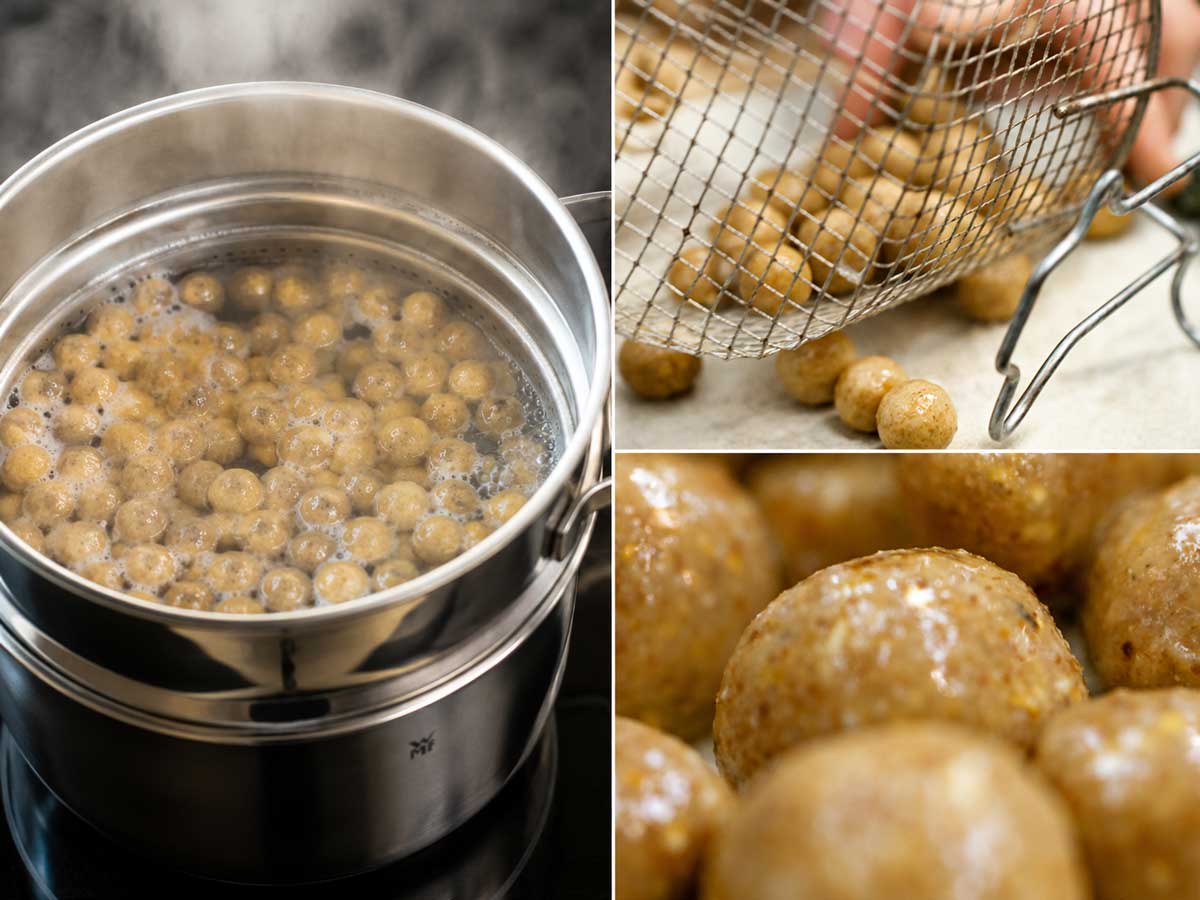
Salt and flavour in the cooking water
If you add the same flavour or suitable attractors to the cooking water, the concentration difference between boilie and water becomes smaller. What is already present in the water is less likely to leave the boilie as strongly. A few splashes of the same flavour per litre of cooking water can reduce flavour loss. Salt also increases the osmotic pressure of the water. This means less water enters the boilie and less carrier liquid transports substances out.
Important: salt also diffuses into the boilie. If a recipe already contains a lot of salt, the dosage must be adjusted. For many boilie recipes, 5–10 g of salt per litre of cooking water is a useful range.
The Frankfurter principle – why the first batches lose more
Every cook knows the principle from Frankfurter sausages: when they are cooked in fresh water, they often taste weaker; after several batches, the water becomes more saturated with Frankfurter aromas. It is similar when boiling boilies. The first batch meets fresh water — the concentration difference is large and the loss is higher. With every further batch, the cooking water becomes more saturated with boilie ingredients. The gradient decreases, and later batches lose less.
Batch 3+: More saturated water → less wash-out and more consistent quality.
Water loss: Water evaporates during boiling. It is better to top up smaller amounts more often than to add a lot at once, so saturation remains more stable.
Changing flavour or mix: Use fresh water when changing to another flavour or mix, otherwise cross-flavours can occur.
Smell changes: If the cooking water smells unpleasant or becomes heavily cloudy, replace it.
In practice: if you boil several kilos of one boilie type, you should not change the water after every batch. It is better to keep using the same water for one type and only replace it when changing to another mix or flavour. The first 200–300 g can be seen as unavoidable sacrificial batches.
When should you change the cooking water?
- When changing flavour or bait type: strawberry water does not belong with fishmeal boilies.
- When the water becomes very cloudy: dissolved protein can coagulate and negatively affect the boilie surface.
- When the smell changes: fats and proteins can become unpleasant during long use.
- After a longer break: do not reheat cooled, previously used cooking water and continue using it.
- When too much water has evaporated: top up small amounts so the pot does not reduce too strongly.
Steaming boilies at home – how it works in practice
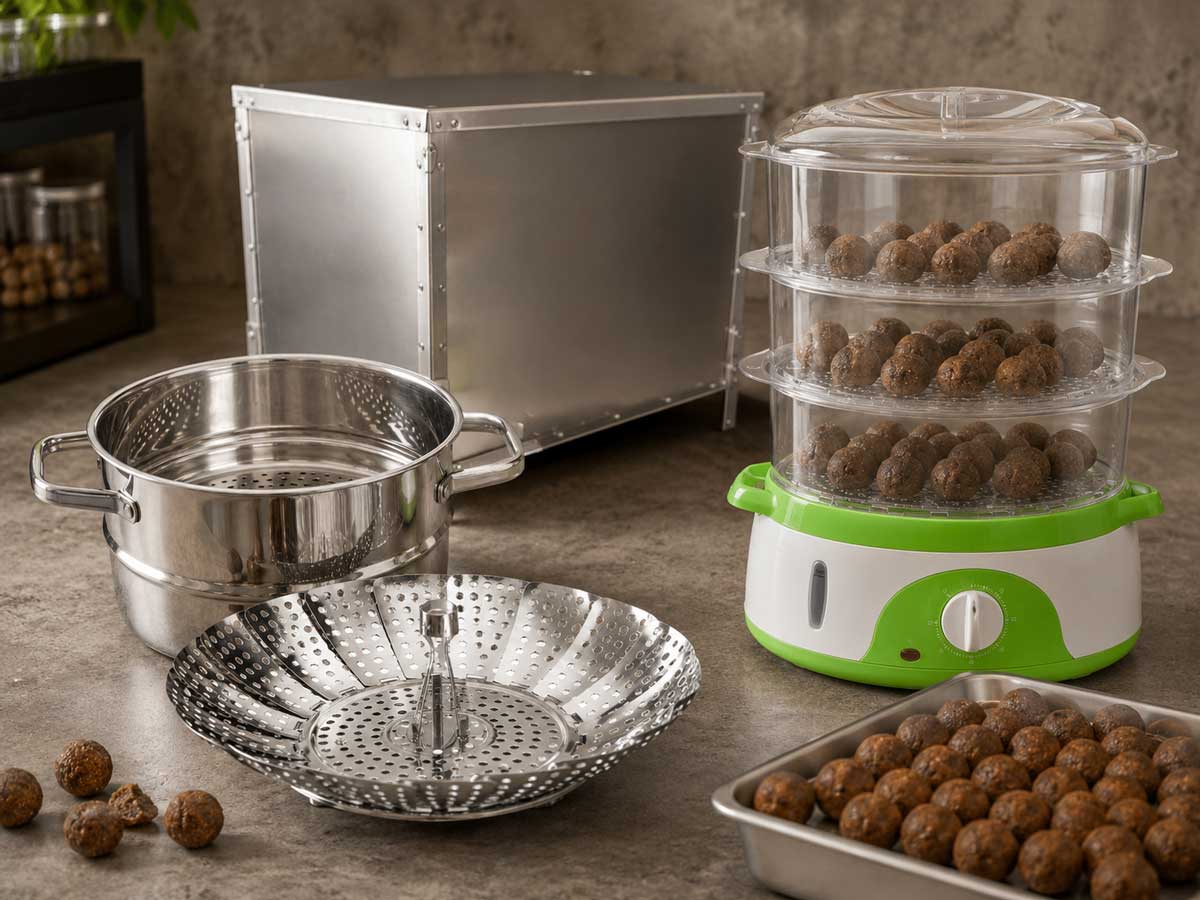
Equipment: for small quantities, a steam insert above a cooking pot is enough. For larger quantities, a preserving cooker with a wire rack insert is a practical and affordable solution. In professional production, combi steamers or steamers with precise temperature control are used.
How to steam boilies:
- Add around 3 cm of water to the preserving cooker or pot.
- Insert the steamer tray or rack.
- Place boilies in one layer with space between them — do not stack them.
- Close the lid and use full power.
- Take the first sample after 8–10 minutes; larger boilies need longer.
- Press individual boilies: even resistance without a soft centre = ready.
- Let the boilies cool down and only dry them afterwards.
Drying: freshly steamed or boiled boilies need around 12–48 hours of air-drying, depending on size, recipe, humidity and desired hardness. Only then should they be frozen or stored. Boilies that are too wet can freeze together, spoil faster or lose surface quality.
Boilies: boil, steam or buy – compare them directly at Carp Austria
Whether you make boilies yourself or buy directly from the producer — at Carp Austria you will find one of the broadest selections of boilies, attractor systems, liquids, pop-ups, wafters, hookbaits and modern carp baits. You can compare baits directly, smell them, test them and speak to producers about ingredients, processing, attraction and specific use cases.
With boilies, this direct comparison makes a real difference: you can see consistency, colour, surface and hardness, compare different attractor profiles and get a better feeling for which baits suit your water. You can also find strong show offers and often buy boilies, pop-ups, wafters, liquids and feeding baits at attractive prices directly on site.
You can ask directly: are the boilies boiled or steamed? Which attractors remain after processing? Which baits are designed for feeding spots, pop-ups, wafters or hookbaits? This direct comparison is valuable for carp anglers who want to understand what they are actually fishing with.
→ Boilie attractors – attractor, feeding stimulant and taste trigger explained
→ Enzymes in boilies – what proteases and amylases really do
→ Feeding boilies – what really belongs in good feed
→ Boilies – ingredients, attractor systems and production
Sources and practical experience
Liu, Y. et al. (2013) — “Effect of protein denaturation degree on texture and water state of cooked meat.” ScienceDirect: comparison of protein denaturation, texture and water state in cooked protein structures. Relevant for understanding temperature, time and structural change.
Anglers’ Net (2015) — “Boilies: Steaming vs Boiling.” Practical comparison of steamed and boiled boilies with reference to steaming times, boiling times and retention of soluble ingredients.
Carp Austria editorial team — Wolfgang G. · certified fish farmer · carp angler for more than 40 years · more than 25 years of experience in boilie making.