Enzymes – the biggest trust issue among all boilie ingredients
“Enzymes in boilies” is currently one of the biggest trends in the carp scene — and at the same time one of the most misunderstood terms of all. What enzymes are, how they work and under which conditions they function: many anglers, and an alarming number of manufacturers, do not have a clear understanding of this.
That makes enzymes the biggest trust issue among all boilie ingredients — and for a reason that does not apply to any other topic in the same way: with poor raw materials, you buy poor quality. With enzymes, that explanation is not enough. A manufacturer can use first-class raw materials — and destroy the entire enzymatic effect through a single processing mistake. The result looks like a good boilie, smells almost like one, and is biochemically ineffective.
The angler cannot see that. He can barely smell it. He cannot test it. He has to trust the manufacturer — or understand the biochemistry himself. This article gives you the knowledge needed to do both.
What are enzymes – the scientific basis
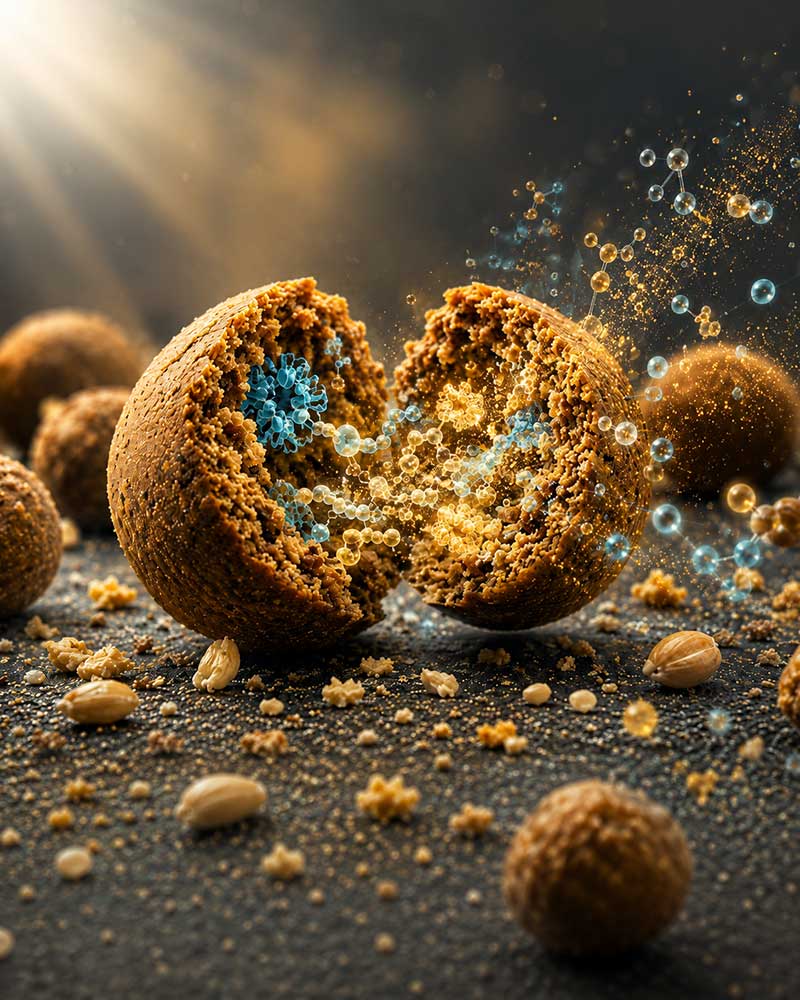
Enzymes are biocatalysts — protein molecules that accelerate biochemical reactions without being consumed themselves. They lower the activation energy of a reaction and make processes possible that would otherwise not take place or would take years.
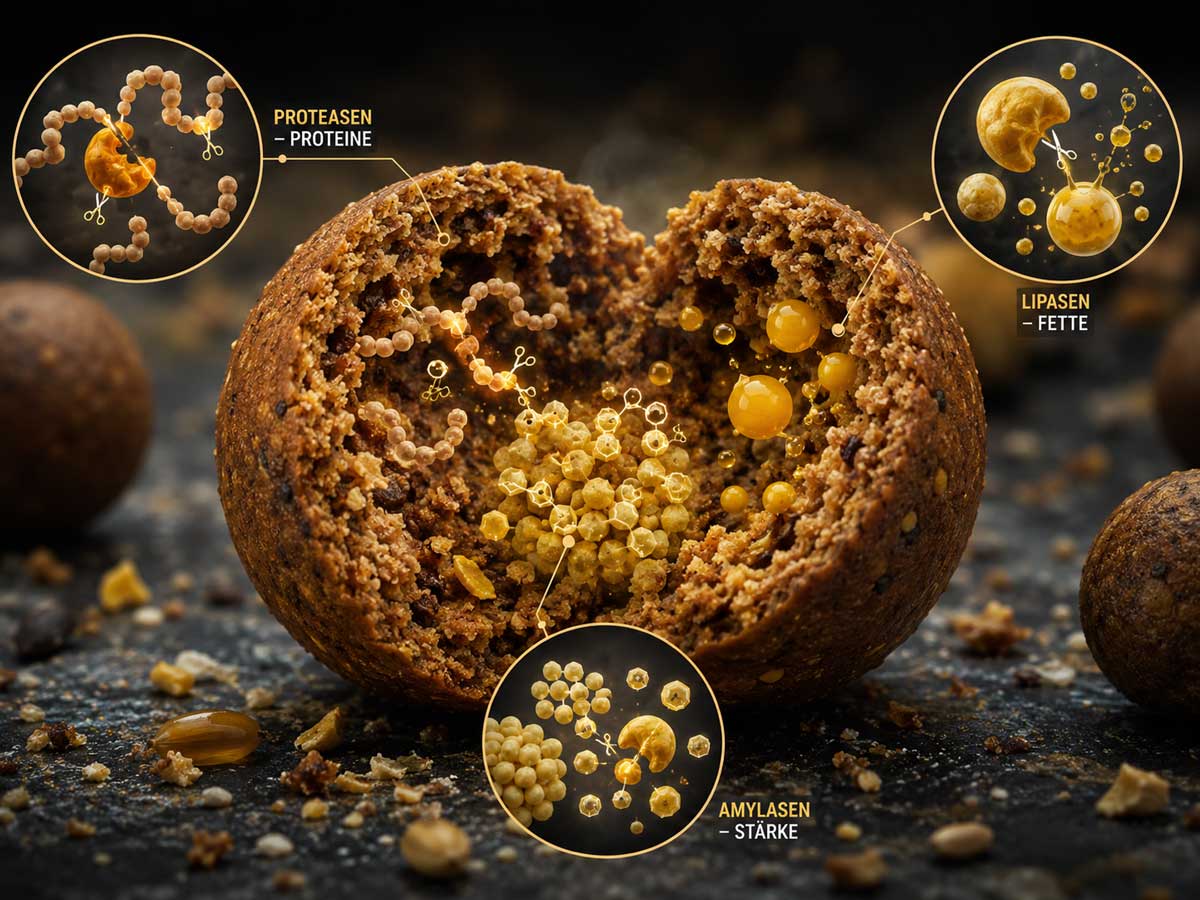
The decisive factor is their functional specificity (functional specificity (substrate specificity)): every enzyme fits one very specific molecule like a key. A protein-splitting enzyme (protease) breaks down proteins — but not fats. A starch-splitting enzyme (amylase) breaks down starch — but not protein. The term “enzymes in boilies” without further specification is about as meaningful as “medication” without saying which one. The question is always: Which enzyme, for which target substance (substrate), under which conditions?
Important first: according to Arlinghaus (2002), enzymes themselves are not attractants for carp — their value lies in what they produce: water-soluble amino acids, simple sugars and fatty acids. These breakdown products are what carp detect and react to.
The three relevant enzyme classes for carp bait
Proteases – the key to the attraction cloud
Proteases split proteins into shorter peptides and finally into free amino acids. This is the most important biochemical process for the attraction effect of a boilie.
Complete protein molecules are too large to dissolve quickly in water. Individual amino acids and short peptides, however, are water-soluble and diffuse immediately. Carp detect them through specialised chemoreceptors in the mouth, lips and barbels. The signal profile of free amino acids is the biochemical equivalent of “real food is here” for a carp. Free amino acids rank second in the attractor hierarchy according to Arlinghaus (2002) — directly after natural extracts from invertebrates.
Protease sources in practice:
- Papain — from papaya latex. One of the most potent natural proteases. Used industrially as a meat tenderiser. In boilies: unlocks fishmeal and liver proteins. Only active in fresh or gently dried form.
- Bromelain — from pineapple. Protease with a similar effect to papain. Fresh pineapple juice is active as a liquid — industrially processed, heated pineapple juice no longer contains active bromelain.
- Microbially produced proteases — from Bacillus subtilis, Aspergillus oryzae. Industrially produced, very efficient, optimised for specific pH ranges.
- Predigested protein solutions (hydrolysates) — fish hydrolysate, squid hydrolysate, krill hydrolysate, liver hydrolysate. The enzymatic process has already been completed — free amino acids are present, the product is heat-stable and can go directly into the boilie mix.
Amylases – starch becomes attractant
Amylases split polysaccharides — complex carbohydrates such as starch — into simple sugars (maltose, glucose). This is important for boilies because starch is water-insoluble: a boilie with a high wheat flour or maize flour content releases very few soluble attractants from its starch fraction. Amylase-treated starch, by contrast, provides immediately water-soluble sugars that diffuse into the water.
The same mechanism explains why fermented grains are so effective: during fermentation, yeasts and bacteria produce amylases that unlock starch into sugars. The enzymatic route is faster and more controllable.
Natural amylase source: raw, unheated honey contains diastase, an amylase. Heated honey no longer contains active enzymes.
Lipases – an important difference compared with oils
Lipases split fats (triglycerides) into glycerol and free fatty acids. An important distinction is needed here: according to Arlinghaus (2002), oils and fats have no attractant effect on carp — they are water-insoluble and cannot be detected by the carp’s chemoreceptors as smell.
The benefit of lipase lies elsewhere: phospholipid-bound fatty acids, such as those in a krill ester blend, have a much better water distribution after enzymatic splitting than pure triglycerides — they emulsify better and spread more evenly in the water. This improves the physical distribution of other water-soluble attractants in the mix. Lipases are therefore more structure improvers than direct attractants.
The most critical point: boiling destroys all enzymes
This is the mistake most manufacturers and anglers make — and it explains why many enzyme boilies do not deliver what they promise.
Enzymes are proteins. At temperatures above 60–70°C they begin to denature — their three-dimensional structure collapses and they lose their catalytic function. At 100°C, the boiling temperature of boilies, all natural enzymes are completely and irreversibly destroyed within minutes.
Consequence: enzymes that are added to boilie dough and then boiled are ineffective after cooking. A manufacturer who adds enzymes to the raw dough and then boils it has no active enzymes left in the final product. The same applies to the Maillard effect: under overheating, amino acids react with carbohydrates to form insoluble compounds — the availability of attractants measurably decreases. (Arlinghaus/Meyer 2002)
The correct point of use — only three methods work reliably:
- Enzyme soak after boiling — soak finished, cooled boilies in an enzyme solution (details below)
- Enzyme-containing liquids as dip or coating — applied directly before use
- Predigested protein solutions (hydrolysates) directly in the dough — the enzymatic process has already been completed, the product is heat-stable and retains its attraction effect even after boiling
Predigested fishmeal – the best-known enzyme product
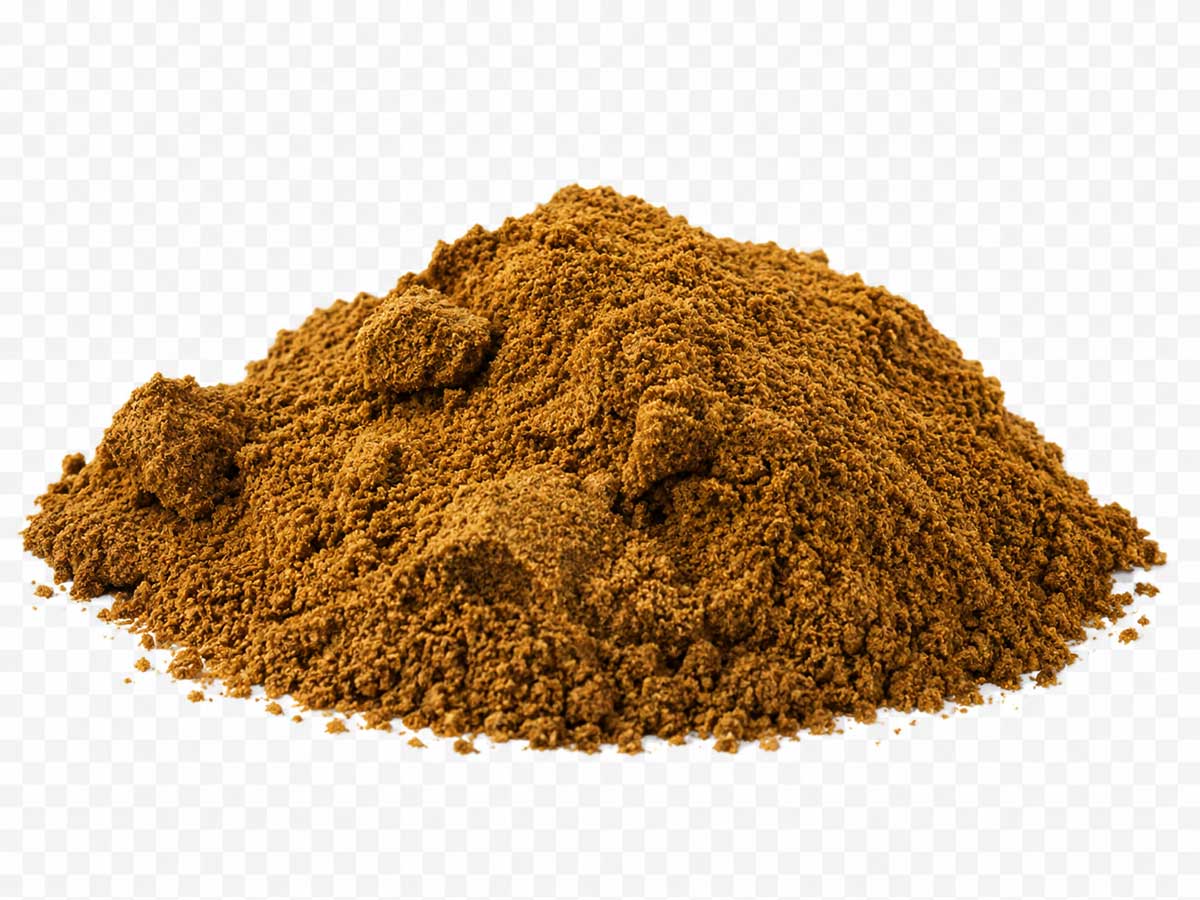
Hydrolysed fish protein is the most prominent and longest-known enzyme product in the fishing industry — even if it is rarely described that way. Fishmeal is treated with proteases under controlled temperature and controlled pH. The protein molecules are split into free amino acids and short peptides.
The result: almost 100% water-soluble, immediate attraction cloud after water contact, easier to digest than complete fishmeal, significantly more intense smell. And crucially: heat-stable — the enzyme product can go directly into the boilie mix without losing its effect during boiling.
When buying, always pay attention to the degree of hydrolysis (DH): a hydrolysate with a high degree of splitting (degree of hydrolysis DH >30%) has more free amino acids and a stronger attraction effect than one with a low degree of splitting.
Important hydrolysate products for boilies:
- Fish hydrolysate — different fish species, broad amino acid profile
- Squid hydrolysate — enzymatically unlocked squid, 95% pepsin digestibility, high proportion of water-soluble peptides. Squid hydrolysate + Scopex = the best-known boilie combination in history
- Krill hydrolysate — intensely marine, rich in DMPT (dimethyl-β-propiothetin), a sulphur-containing attractant from marine algae that has been shown to trigger feeding reflexes in carp — with a stronger effect than glutamine (scientifically confirmed, Nakajima 1989)
- Liver hydrolysate — highly soluble beef liver, releases betaine immediately
- Casein hydrolysate — unlocked milk protein, creamy-sweet, for light milk protein mixes
Process conditions – temperature and pH
Two factors matter for a correct enzyme soak:
Temperature optimum: the optimum temperatures differ: papain from papaya works best at 60–65°C, bromelain from pineapple at 50–60°C, and starch-splitting alpha-amylase at 55–70°C. For enzyme soak, this means: soaking boilies in a 50–60°C warm enzyme solution is far more effective than cold soaking — the water penetrates faster and both main enzyme classes work within their optimum range.
pH optimum: neutral proteases work at pH 6–8 — matching most boilies (pH 7–8). Acidic enzymes such as pepsin, pH 1.5–2, would be ineffective in a neutral boilie. For boilie applications, always choose neutral or slightly alkaline enzyme preparations.
Fermentation vs. enzymatic breakdown — the big comparison
Fermentation and enzymatic breakdown create the same end products — free amino acids, simple sugars, fatty acids. The process is fundamentally different:
This explains why fermented grain often smells more intense than enzymatically treated grain despite the slower process: the by-products (butyric acid, esters, alcohols) are themselves a strong attractant signal for carp — butyric acid ranks at the very top of the attractor hierarchy. Enzymatic breakdown is “cleaner” but not automatically more catch-effective.
Are enzymes the same as bacteria in sourdough, yeast or salt fermentation?
No — but they are closely related. The difference is fundamental and explains why both processes produce different results.
Enzymes are isolated protein molecules — no cells, no metabolism, no reproduction. They are the tool. A protein splitter (protease) breaks proteins into amino acids. That is it. Nothing else.
Bacteria and yeasts are living organisms — they produce enzymes as part of their metabolism and much more besides. When Lactobacillus bacteria break down particles during salt fermentation, several processes happen at the same time:
- Proteins → free amino acids through bacterial proteases
- Starch → sugars → lactic acid, acetic acid, butyric acid through bacterial metabolism
- Additionally: esters, complex aroma molecules — a biochemically richer profile than isolated enzymes could ever produce
Butyric acid is not produced by enzyme treatment. It is a by-product of bacterial metabolism. Isolated enzyme treatment alone does not produce it — this is the biochemical reason why fermented baits rank at the top of the attractor hierarchy.
The analogy: sourdough (Lactobacillus + wild yeasts) → complex profile of lactic acid, acetic acid, CO₂ and hundreds of aroma compounds. Isolated amylase → only starch to sugar. No sourdough aroma, no complexity. Fermentation with brine or yeast is, in this sense, the natural enzyme soak — with the decisive advantage that living organisms continuously produce new enzymes and adapt to the substrates.
The optimal strategy combines both: predigested protein solutions (hydrolysates) and enzyme soak (fast, controlled, reliable) + fermented components (biochemically rich, butyric acid, complex attractants). Each approach does what the other cannot.
Natural enzyme sources in normal ingredients
Many boilie ingredients naturally contain active enzymes — even if it is not written on the packaging:
- Fresh pineapple — contains bromelain (protease). Fresh pineapple juice is active as a liquid. Industrially processed, heated pineapple juice no longer contains active bromelain
- Fresh papaya — contains papain (protease). As fresh extract or papaya powder from raw fruit
- Raw, unheated honey — contains diastase (amylase) and glucose oxidase. Heated honey no longer contains active enzymes
- Fermented CSL (Corn Steep Liquor) — contains active enzymes from the fermentation process that further unlock starch residues
- Fermented particles (hemp, tiger nuts) — contain active enzymes from fermentation microorganisms after fermentation
Enzymes in practice – four application methods
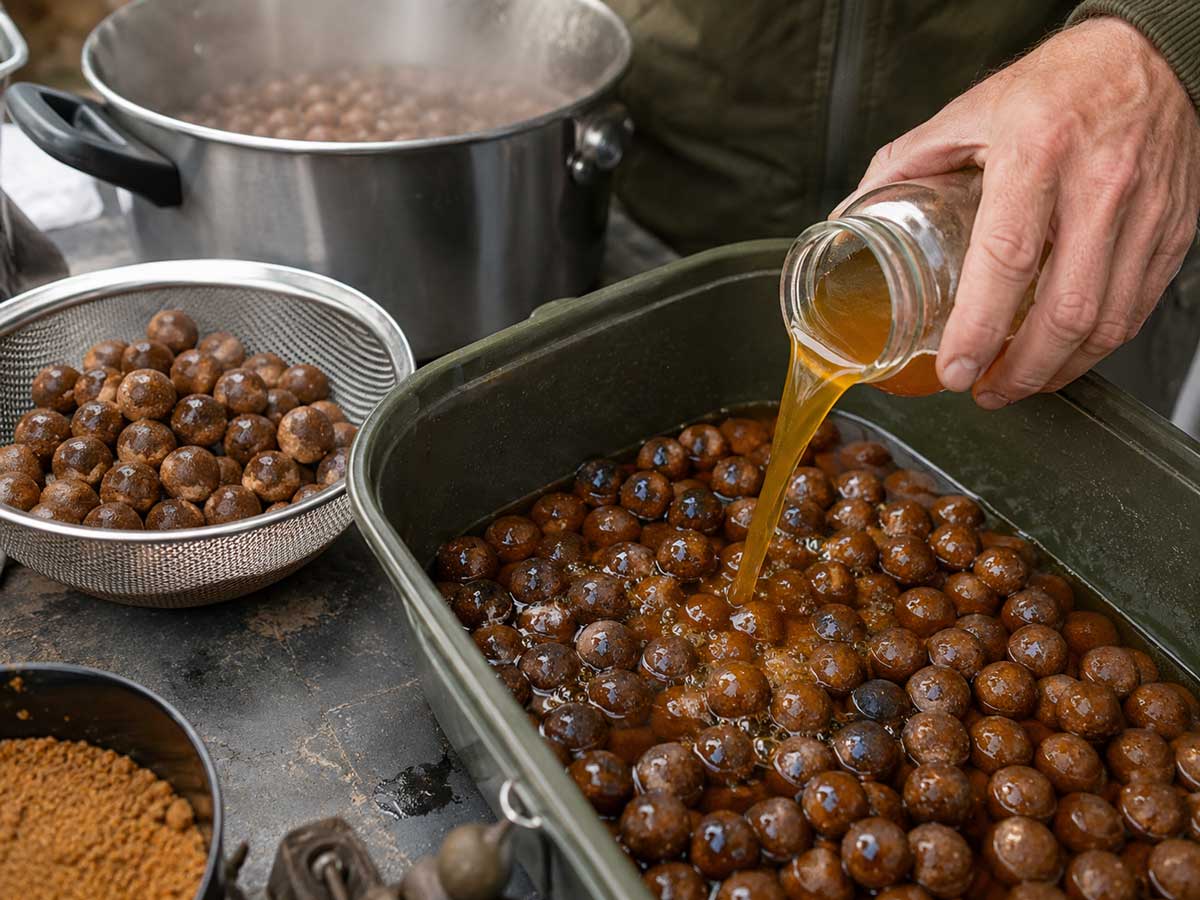
Method 1 — enzyme soak after boiling (recommended)
- Boil finished boilies and allow them to cool completely to room temperature
- Dissolve enzyme liquid in lukewarm water (35–45°C)
- Soak boilies for 12–48 hours
- Allow to dry to the desired residual moisture
- Freeze or use immediately
The enzyme penetrates the boilie structure and continues working even after freezing, at a slower rate at low temperatures. For hookbaits, this is the best method.
Method 2 — predigested protein solutions (hydrolysates) directly in the dough
The safest and most reliable method. Ingredients that have already been enzymatically unlocked retain their attraction effect even after boiling because the enzymatic process has already been completed. Add fish hydrolysate, squid hydrolysate, krill hydrolysate and liver hydrolysate directly to the boilie mix.
Method 3 — enzyme coating / enzyme dip
Concentrated enzyme liquid as a hookbait dip shortly before casting. Immediate effect on the boilie surface. Limited depth effect — ideal for instant sessions without an established feeding spot.
Method 4 — enzymes for particles
Soak hard maize, tiger nuts or hemp in enzyme solution after boiling. Amylase breaks down remaining starch, protease unlocks protein. Result: particles with significantly increased attraction without the extra cost of expensive hydrolysates.
Which enzyme for what – overview
Preservatives and enzymes – an underestimated contradiction
This point is almost never discussed in the fishing industry — even though it has a direct impact on the effectiveness of many enzyme boilies. Most shelf-life boilies are preserved. And the most commonly used preservatives inhibit or destroy enzyme activity — including enzymes from the food industry.
How preservatives attack enzymes
Potassium sorbate (E202) / sorbic acid — the most critical combination. Sorbic acid reacts with sulphur groups (sulphur groups (thiol groups)) in enzyme molecules. Particularly affected: protein-splitting enzymes (proteases) that require a cysteine sulphur group centre for their function — including papain and bromelain. This inhibition mechanism is scientifically well documented (IC₅₀ of potassium sorbate for enzyme inhibition: 14 mg/L — far below the concentrations used in boilies). An enzyme boilie preserved with potassium sorbate has no active cysteine proteases left after preservation.
Sodium benzoate (E211) — inhibits a broad range of enzymes at the concentrations commonly used in boilies (0.1–0.3%). Not as specific as sorbate, but measurably effective as an enzyme inhibitor.
Propionates (E280/281) — lower direct enzyme effect, mainly antimicrobial. Less problematic for isolated enzyme preparations.
Salt (NaCl) — in high concentrations, salt denatures proteins and therefore also reduces enzyme activity. In moderate amounts, less problematic than chemical preservatives — but still not an entirely harmless enzyme soak partner.
Tocopherols / vitamin E (E306–309) — no problem. Antioxidants, no antimicrobial effect on enzyme proteins. Enzyme-compatible.
When the contradiction matters — and when it does not
The preservative-enzyme conflict is only relevant when enzymes are supposed to remain active in the finished boilie — meaning enzyme soak or enzyme dip on shelf-life boilies. Potassium sorbate or benzoate in the finished boilie inactivates soaked-in enzymes on the surface.
For manufacturers who perform the enzymatic breakdown before boiling in the raw dough, this point is irrelevant: the enzymes have already done their work in the dough, are destroyed during boiling, and the preservation-resistant breakdown products (free amino acids, sugars) remain in the boilie. Preservation then only protects the finished product — not active enzymes.
Practical recommendation: anyone who wants to use enzyme soak or enzyme dip should use freezer boilies — no preservatives, no enzyme conflict. Shelf-life boilies with potassium sorbate or benzoate are biochemically unfavourable for later enzyme treatment. The use of tocopherol-preserved boilies is an acceptable compromise.
Critical assessment – what really works
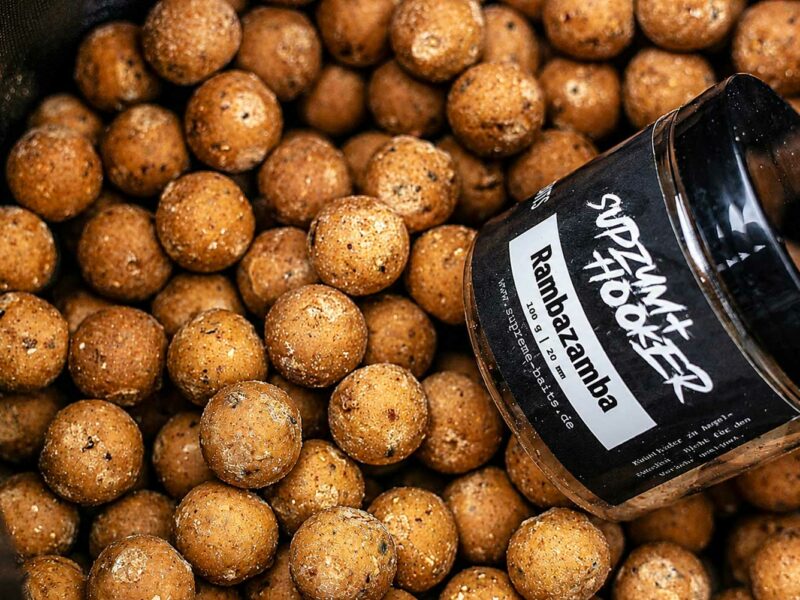
Serious and proven: predigested protein solutions (hydrolysates) directly in the mix (heat-stable, reliable). Enzyme soak after boiling at the correct temperature (35–50°C) and pH. Complete dough treatment before boiling — the enzymes do their work in the raw dough, are destroyed during boiling, but their products (free amino acids, monosaccharides) remain heat-stable in the boilie. This is the most advanced approach — Supreme Baits SupZym+ applies it with a patented process.
Questionable: enzymes added during boiling — denatured afterwards, zero effect. “Enzyme boilies” without stating which enzymes and how they were processed. Claims of “activated” enzymes that survive boiling.
The simple test: does an enzyme boilie smell more intense than a comparable normal boilie? Is the smell more complex, deeper — less like synthetic flavour, more like real food? Then the enzyme treatment has been carried out correctly. No difference in smell = no active enzyme effect.
Conclusion – two rules decide everything
Enzymes are not a marketing gimmick — they are real biochemistry that delivers real results when used correctly.
Rule 1 — no boiling after enzyme addition. Enzyme soak and enzyme dip always after boiling and cooling. Anyone who adds enzymes beforehand wastes money.
Rule 2 — hydrolysates are the simplest solution. Predigested protein and carbohydrate sources (fish hydrolysate, squid, krill, liver) reliably deliver the enzymatic attraction effect without process risk — and can go directly into the boilie mix.
The best combination: hydrolysates directly in the mix + enzyme soak after boiling for hookbaits + natural enzyme sources (papain, bromelain, fermented CSL) as a boost.
→ All background on ingredients, attractant systems and betaine in the complete Boilie Guide.
→ What really belongs in good feeding bait: Feeding Boilies Guide.
→ All boilie brands at Carp Austria at a glance.
Scientific sources
Arlinghaus, R. & Meyer, J. (2002) — “Wieso, Weshalb, Warum – Part 3”. Scientific analysis of attractants, amino acids, betaine, flavour biochemistry and attractant hierarchy in carp. Includes the assessment: enzymes, lecithin, oil/fat = no attractant effect.
Arlinghaus, R. & Meyer, J. (2001) — “Wieso, Weshalb, Warum – Part 4”. Five factors for food intake in carp.
Nakajima, K. et al. (1989) — “A New Feeding Attractant, Dimethyl-β-propiothetin, for Freshwater Fish”. Nippon Suisan Gakkaishi 55(4): 689–695. Evidence of DMPT as a feeding trigger in carp with a stronger effect than glutamine.
Smith, L.H. & Hong-Shum, L. (2003) — Food Additives Data Book. Papain optimum temperature 65°C, pH range 5–8.
Carp Austria Editorial Team – Master Craftsman Thesis 2008, Wolfgang G. Certified fish farmer · angler for over 45 years