Carp eat almost anything – and that is exactly what gets exploited
Carp could almost be called pond pigs. There is hardly anything they will not try to suck into their mouth while searching for food. That is exactly why fake baits work so well in carp fishing — even if the carp immediately notices that the fake corn is not food, it is often too late because of the self-hooking mechanics of modern carp rigs.
Sadly, some feeding boilie manufacturers exploit this behaviour without shame. Bright balls made from semolina, glue, colourants and flavour — the carp eats them because it eats almost anything. But it gets nothing from them. No protein, no nutritional value, no energy. And the angler wonders why the bites slow down even though carp are on the spot.
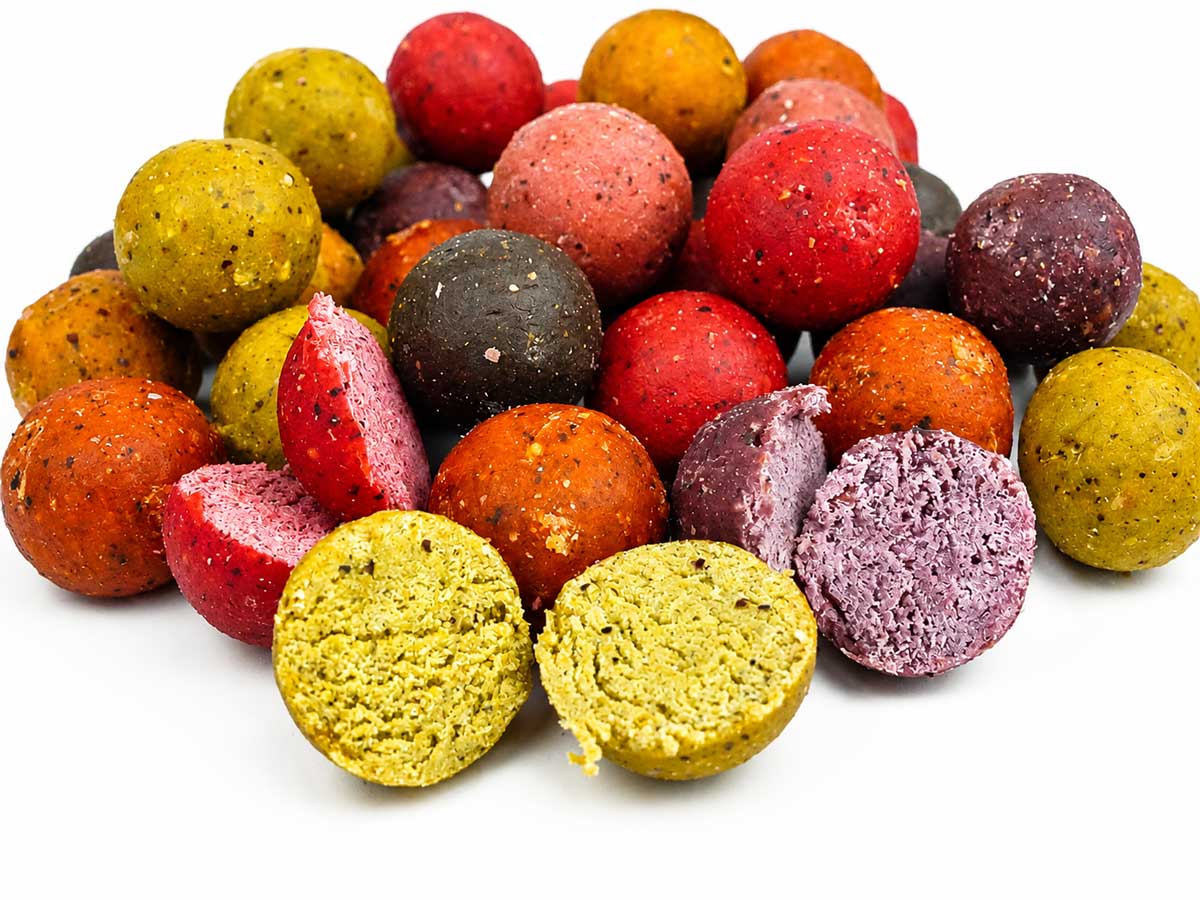
As a leading trade fair for carp fishing, we see it as our responsibility to write a few clear lines about healthy and balanced carp feed. What really belongs in a good feeding boilie, how much you should bait, and why cheap feed can become the most expensive decision at the water — that is what you will learn here.
How carp feed in nature
Carp are omnivores. In natural waters, they use a wide range of natural protein sources:
Zooplankton — especially water fleas are an absolute favourite food source. The key point: zooplankton is the only natural food source that keeps multiplying from spring onward. Under good conditions, a generation of water fleas reaches sexual maturity every 10 days. When stocks are high, no fishing bait can compete with this natural flood of food — the saturation level is simply too high. Signs: greenish, cloudy water and small organisms visible in a white bucket. Then reduce bait quantity drastically and rely on visual triggers.
Insect larvae — mosquito larvae (Chironomidae/bloodworm), mayfly larvae, sludge worms. Rich in protein, fats and minerals. Bloodworm extract in a boilie targets exactly this food source. For carp, a boilie with real bloodworm extracts and butyric acid is a familiar food signal from the sediment — conditioned suspicion is hardly possible.
Snails and mussels — easily digestible protein, rich in calcium. Carp in gravel pits feed heavily on mussels — which is why smaller but continuous baiting is often more effective in these waters than large one-off quantities. GLM (Green Lipped Mussel) in the boilie mix matches exactly this natural feeding signal.
Small fish and fish spawn — especially for large carp. This explains why fishmeal and marine attractors are so effective and why extracts from crustaceans and worms rank at the very top of the scientific attractor hierarchy.
Aquatic plants — rich in fibre and supportive for healthy gut flora.
From a carp’s perspective, no fishing bait can be as tasty as natural, easily digestible food. That is the benchmark every feeding boilie has to meet.
What belongs in a feeding boilie
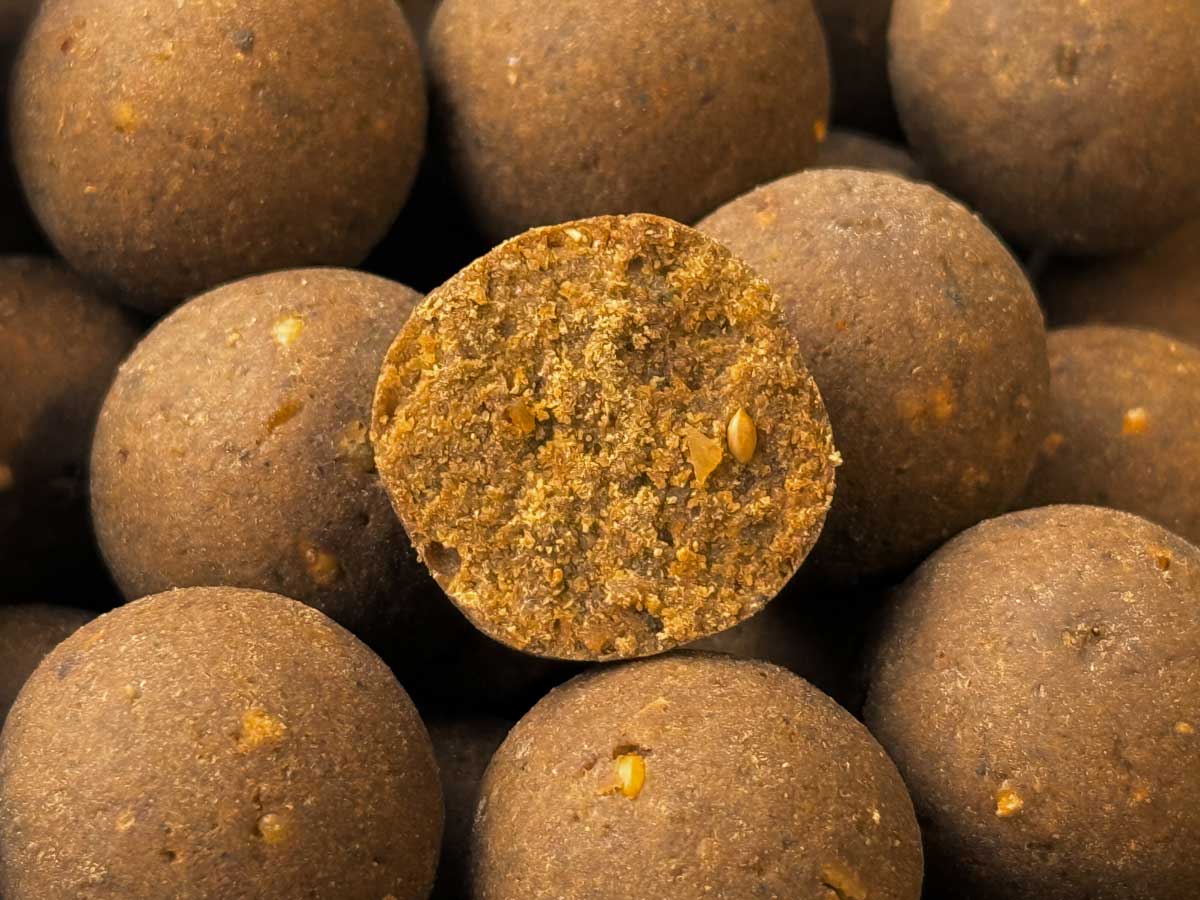
Keep it simple, but efficient. A feeding boilie should contain what tastes good to the fish — not what smells good to the angler. What benefits the fish — not what looks good.
The attractor hierarchy – what really triggers carp
Not all attractors are equally effective. According to scientific evaluation of carp research (Arlinghaus 2002), attractors work in the following order — from strongest to weakest effect:
- Natural extracts from invertebrates — crustaceans, worms, mussels, fish. Extracts from worms and crustaceans outperform mussel and fish extracts.
- Ingredients with a high share of free amino acids — liver meal, fish and meat meal, milk proteins, blood meal, brewer’s yeast.
- Synthetic amino acid blends with glycine betaine — better than single amino acids.
- Single amino acids — L-proline, the most effective, glycine betaine, peptides.
- Natural substances — spices, alcohols, sugar compounds, salts.
No effect as an attractor: enzymes, lecithin, oil and fat — they only have nutritional functions. Repellent effect: bitter substances, strong acids — and preservative acids in shelf-life boilies inhibit bacteria and also reduce bait attractiveness.
Quality protein sources:
- LT fishmeal (low-temperature process) — herring fishmeal, digestibility 92–97%. LT means gentle processing, with higher vitamin and mineral content than HT fishmeals. HT fishmeals (high-temperature process) have reduced biological availability due to the harsh production method.
- Krill meal — highly attractive, high in protein and fat, rich in omega-3 and omega-6 fatty acids. Krill Esterblend (phospholipid-bound omega-3) is up to 10× faster water-soluble than normal krill oil — and therefore far more effective as an attractor.
- Enzyme-treated fish protein / hydrolysate — spray-dried, fully water-soluble, high in free amino acids and peptides. Immediately detectable. It sits at level 1 of the attractor hierarchy.
- Poultry meal — a good, easily digestible protein source with a complete amino acid profile.
- Full-fat soya flour — contains all essential amino acids, rich in lecithin, a natural emulsifier that binds oil and water in the dough, lysine and polyunsaturated fatty acids.
- Milk proteins (casein, lactalbumin) and calf starter — easily digestible, immediate attraction cloud from water-soluble peptides. Calf starter (milk replacer) is an underrated and cost-effective alternative: it contains around 50% skimmed milk powder (casein + lactalbumin), lactose for an instant attraction cloud, essential amino acids (lysine, methionine, threonine) and often added betaine. Available from agricultural suppliers or farming cooperatives. Dosage in the mix: 10–20% as a partial replacement for more expensive casein meals.
Quality carbohydrate sources:
- Fermented grains — enzymatically treated, starch broken down into glucose and maltose, immediately water-soluble and attractive. At the same time, butyric acid and organic compounds are formed that resemble natural sludge — a familiar food signal for carp.
- Corn Steep Powder (CSL) — fermented maize extract, fully water-soluble, instant attraction cloud. One of the cheapest and most effective feeding attractors available.
- Heat-treated cereal flours — easier to digest than raw flour: maize, wheat, barley, rice, oats, millet.
Fats and oils:
- Fish oil, soya oil — fat content in the mix should be close to 10%, at least 5%. Fat is the main energy source for carp and important for fat-soluble vitamins. Important: oils only work as attractors at water temperatures above 12°C — below 10°C they hardly diffuse in water and are not detectable by carp through smell.
- Hemp meal and pumpkin seed meal — both are press residues from oil production and are much cheaper than the respective oil, with an almost identical nutrient profile. Hemp meal: around 30–35% protein, optimal omega-3/omega-6 ratio, nutty-earthy natural smell. Pumpkin seed meal: around 35–40% protein, around 25% residual fat content, intense nutty smell, dark green colour. Both can be worked directly into the boilie mix — pumpkin seed meal up to 15%, hemp meal up to 20% dosage.
Essential additives:
- Betaine (glycine betaine = N-trimethylglycine) — only real glycine betaine with the structural formula (CH₃)₃N-CH₂COOH is effective. Other betaines (ornithine, histidine) have been proven ineffective for carp. Betaine mainly works as a sensitiser: it lowers the stimulus threshold for other amino acids — the carp tastes all other attractors more intensely. Best effect: glycine betaine combined with an amino acid blend. Natural sources: sugar beet, molasses, barley, mussels, worms, liver meal. Effective all year round, especially at low temperatures. (Arlinghaus/Meyer 2002)
- Brewer’s yeast / brewer’s yeast extract (Brocacell) — supports gut flora, contains a complete essential amino acid profile and over 50% protein, of which up to 90% is water-soluble. The decisive additional effect: glutamic acid creates an umami taste that makes all other flavour components in the boilie more intense — brewer’s yeast is both attractant and enhancer. Dosage in the mix: 3–10%. The professional trick: sprinkle brewer’s yeast powder over the still-hot boilies after boiling and shake well — the powder sticks to the surface as an immediate attraction cloud.
- Amino acids — complete profile for optimal detection. L-proline and L-alanine are the most effective single amino acids for carp (Japanese research, 0.001 to 10⁻⁹ molar). Amino acids work stronger in combination than individually — this is the main advantage of natural extracts over synthetic single substances.
- Vitamins and minerals — essential for growth, immune system and health.
- Probiotics and prebiotics — support beneficial gut bacteria, improve digestion and nutrient utilisation.
Important production note: The boiling time should be kept as short as possible. During boiling, water-soluble attractors are washed out. Then there is the Maillard reaction: amino acids can combine with carbohydrates under overheating and form insoluble compounds — the availability of attractors drops measurably. Attractors (betaine, amino acid powder, brewer’s yeast) are better applied after boiling as a dip or powder coating on the still-hot boilie. (Arlinghaus/Meyer 2002)
What does NOT belong in a feeding boilie
Oil-based flavours — the most important and most ignored point. Oil is completely insoluble in water. Carp detect attractors exclusively through water-soluble compounds — their sense of smell only works through chemical compounds that dissolve in water. All oil-based flavours are not detectable by carp through smell. What the carp detects are the water-soluble carrier substances. Flavour in a feeding boilie is marketing for the buyer — not for the fish. (Arlinghaus/Meyer 2002)
Synthetic colourants — including uranine, a fluorescent dye that is actually used as a tracing dye for leak detection in industry. It has no place in carp feed. Bright colours are not a signal to carp in a feeding boilie — colour does not matter to carp when searching for food in mud and sediment.
Methylcellulose — wallpaper paste as a binder. It holds the boilie together and has zero nutritional value. A clear sign of a mix with too few quality protein meals that would naturally bind.
Propylene glycol — an industrial preservative from the cosmetics and antifreeze industries. It explains why some cheap boilies can lie in the water for weeks without rotting — no microorganism breaks them down. For the biological breakdown process in water, which is what makes a feeding boilie truly attractive, this is fatal.
Preservatives of any kind affect biological breakdown processes in water — and therefore exactly the process that makes a feeding boilie more attractive after hours in the water. Natural preservation through salt, freezing or alcohol, as used by MM Baitservice, is always better. Preservative acids inhibit bacteria and also reduce the attractiveness of the bait for carp.
Too much protein is also counterproductive: the optimal crude protein content is 25–50%, with carp utilising around 40% most efficiently. Any additional protein is burned for energy — producing ammonia as a waste product that is excreted through the gills. Under poor environmental conditions — low oxygen levels, high water temperature — ammonia excretion can become harder and the fish can poison itself. This scientifically explains why bites slow down after several days of intensive HNV baiting.
Avoid hard-to-digest protein sources: HT fishmeal (high-temperature process), wheat flour, potato protein and pea flour are difficult to digest. What the gut cannot use enzymatically is excreted or stresses the fish — because carp do not have a true stomach capable of breaking down poorly soluble ingredients.
Seasonal strategy – spring, autumn & winter = protein, summer = carbohydrates
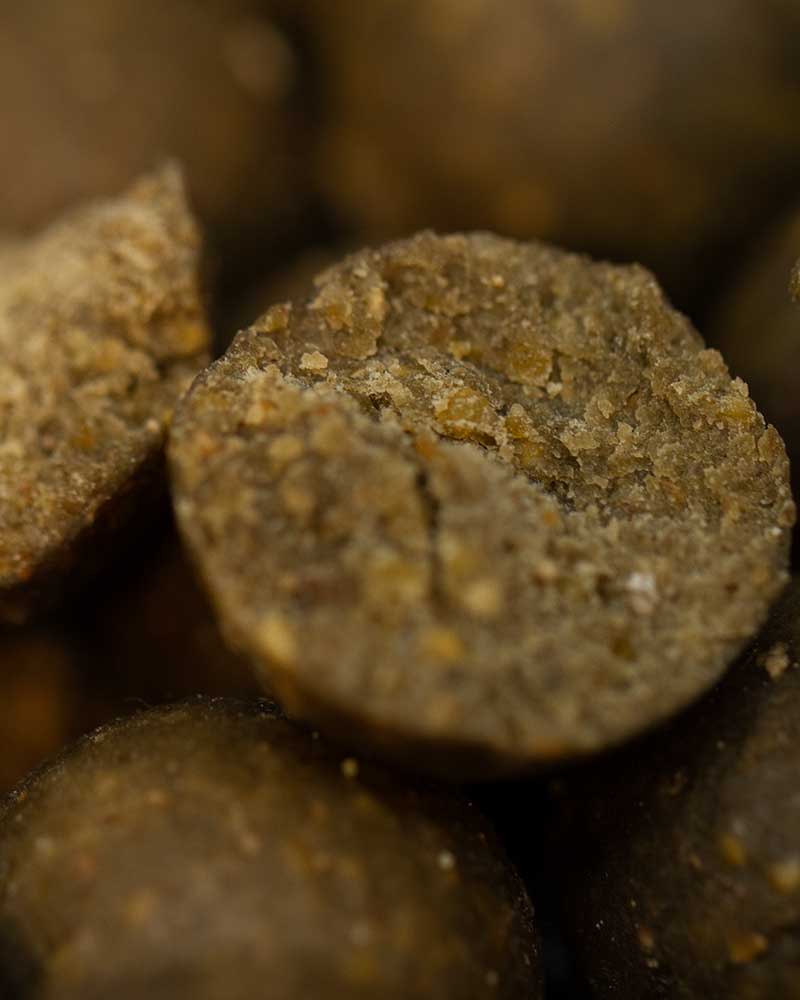
Every fish farmer gives carp a completely different feed in spring with still-cold water, or in autumn, than in midsummer. As a carp angler, you should do the same.
Roughly speaking: spring, autumn & winter = protein. Summer = carbohydrates.
In summer, a lot of natural food has built up in the water — carp can rely on top-quality protein from natural sources. Excessive protein intake at high temperatures leads to increased ammonia excretion — a burden for fish and water. When it gets colder and natural food starts to decline, carp need fat reserves for winter — then animal protein becomes important again.
Golden autumn – big fish time
The nights get cooler. The water is still warm. The fish feel it — now it is time to build winter reserves.
The big feed begins. Carp search intensively for protein sources to build fat reserves that will carry them through winter. That is exactly what makes autumn the best time for big carp — even if the number of bites drops overall.
Why fewer bites but bigger fish? The natural protein sources in the water are no longer as abundant as in spring — insect larvae, zooplankton and worms have largely been reduced over the summer. The saturation level drops — and the willingness to take risks rises. A hungry carp is less selective. (Arlinghaus/Meyer 2001)
This is your big chance. A quality protein boilie with LT fishmeal, krill meal or beef liver extract now matches exactly what the carp is looking for. Not a midsummer fruit boilie — now is fishmeal time.
Intensive pre-baiting over several days pays off more in autumn than in any other season.
How much to bait – guidelines from fish farming
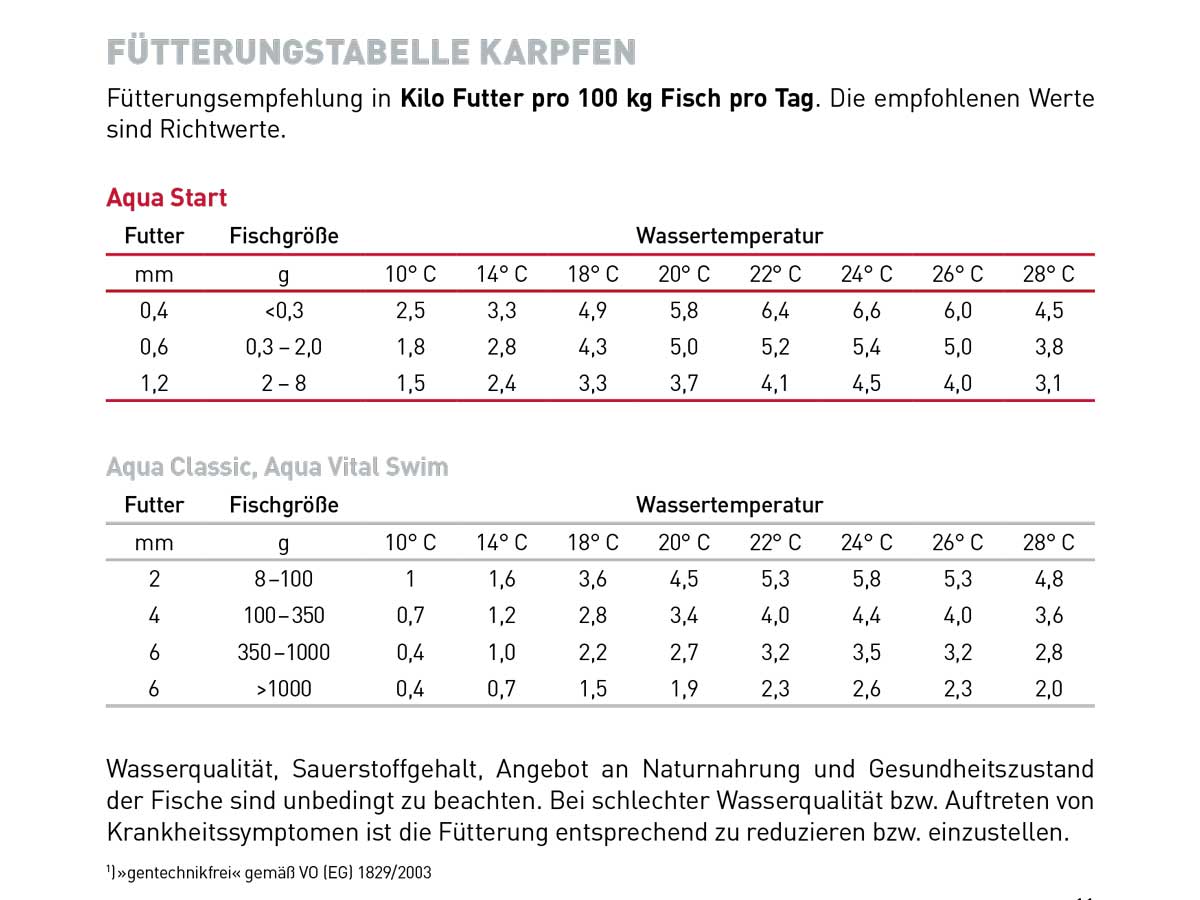
The Aqua Garant feeding table shows recommended feed quantities in kilograms per 100 kg of fish weight per day — guidelines from professional carp farming. Applied directly to feeding boilies at the swim:
A big 10 kg carp eats only around 40 g per day at 10°C — and over 260 g at 24°C. The difference is sixfold. This explains why the same baited spot can remain untouched for days in winter and be cleared within hours in midsummer.
The practical calculation:
If an estimated 100 kg of fish weight is swimming in your fishing area — on a well-stocked carp lake this means around 13 to 14 carp over 7 kg — the total daily bait quantity at 20°C should not exceed 1 to 1.5 kg of feeding boilies. This is derived from fish farming guidelines — and the natural food supply has not even been included yet.
At a water temperature of 10°C: maximum 400 g. Anything beyond that lies untouched for days, stresses the water and makes the spot worse instead of better.
The scientific reason why too much bait ruins bites: saturation level is factor no. 5 in carp feeding behaviour — and the most underestimated one. A full carp is highly selective and no longer takes risks. It watches the spot, may even feed — but it makes no mistakes. Anyone who baits too heavily should not be surprised when bites stop although carp are present: they are simply full. (Arlinghaus/Meyer 2001)
In low-stock waters with rich natural food — such as gravel pits with strong mussel stocks — less bait, but baited daily, is often the better strategy than large one-off quantities.
The 5-minute rule from fish farming: only feed as much as carp will eat completely within 5–10 minutes. What remains lowers oxygen levels and promotes disease.
Important during oxygen shortage: reduce bait quantity immediately under heat stress above 26°C. In waters rich in aquatic plants, extreme oxygen fluctuations can occur in midsummer — shortly before dawn, O₂ values can fall below 4 mg/L because plants consume oxygen at night. During prolonged cloudy summer days, it becomes especially critical: plants produce hardly any oxygen, but start consuming it earlier. Carp then stop feeding completely — baiting is counterproductive. Aqua Garant is represented at Carp Austria.
How to bait – strategy at the water
Wide spread instead of pinpoint: spreading feeding boilies over a larger area brings carp into the zone from different directions. Pinpoint baiting only makes sense once the baited spot is established.
Precisely around the hookbait: the bed of bait must surround the hookbait — not sit away from it. Carp actively feeding in the bait take the hookbait as a natural part of the baited spot. Use a spod or baiting spoon so the hookbait always sits in the middle. A PVA bag directly around the hookbait releases the instant attraction cloud exactly where the hook is.
Silver fish and bream pressure decides the tactic:
Low silver fish and bream pressure → small, soft feeding boilies (12–15 mm). They release more attractors and remain selective for carp.
High silver fish and bream pressure → large, hard feeding boilies (20 mm+) that physically overwhelm bream and silver bream. In addition, bait with particle baits — tiger nuts, hemp, maize. Groundbait as an attraction component dissolves immediately and forms a cloud without permanently feeding off silver fish and bream.
Making feeding boilies more attractive – liquids, powders and dust clouds
A good feeding boilie works by itself. A boosted feeding boilie works immediately and more intensely.
Liquid soak: soak feeding boilies in a liquid before use — GLM liquid, krill hydrolysate, liver extract or CSL. Dry boilies absorb the liquid deeply. The base is decisive: hydrolysate-based liquids (squid, krill, GLM) work all year round and also in cold temperatures because they are fully water-soluble. Oil-based liquids (fish oil, salmon oil) only work from around 12°C — below 10°C, oil hardly diffuses in water and is not detectable by carp.
Powder coating: lightly oil the boilies, then roll them in attractor powder — brewer’s yeast extract, betaine powder, krill hydrolysate powder. On impact, the powder dissolves immediately as a visible dust cloud. Carp recognise this cloud visually and chemically at the same time. The powder method also avoids the Maillard problem: attractors are added after boiling and remain 100% effective.
The dust cloud is more than visual effect. Fine particles and attractor powders spread horizontally in the water and form a bottom-level attraction cloud that slowly expands. Carp nearby notice the baited spot visually — they see the cloud before they smell it. Especially effective in clear water and during active feeding behaviour.
Add spod mix and stick mix: feeding boilies alone do not create an instant attraction cloud. Mixed with fine stick mix or spod mix — crushed boilies, pellets, hemp, CSL liquid — a staggered timeline is created: fine particles dissolve immediately, boilies work for hours. This is the combination that brings carp to the spot quickly and holds them there.
Coarse salt — one of the oldest and most effective tricks. Roll feeding boilies in coarse sea salt shortly before casting. On impact, an instant salt cloud forms in the water. Carp love salt as a mineral source — sodium directly stimulates feeding reflexes and is detectable by carp through chemoreceptors. At the same time, salt hardens the outer layer. A handful of coarse salt per kilo of feeding boilies — shake briefly just before casting.
Important: liquids and powders do not fix a poor feeding boilie. They amplify what is already good — nothing more.
The most common mistake in a baiting campaign
Cheap bait, expensive hookbait. The logic sounds sensible — but it does not work.
Quality ingredients that are truly attractive to carp simply cost many times more than maize meal or semolina. It is no problem to buy feeding boilies on the European market for under two euros per kilo — maize, wheat semolina, paste, colour and oil-based flavour that the carp cannot detect anyway. What can be read on some labels — propylene glycol as preservative, 17–19% crude protein, simple cereal flours — is not carp feed. It is filler.
Most anglers buy cheap feeding boilies and expect bites on their hookbait packed with the best ingredients. Cheap feeding boilies may attract carp to the spot in the short term. But a long-term baited spot only works if carp find real value — and feed actively and confidently. Not if they sniff and move on. The attractant brings the fish to the bait. The palatant decides whether it stays.
The hookbait is only as good as the bait that makes the carp take it. A carp on the baited spot only has to put something in its mouth once — to be caught.
Feeding boilies and hookbaits should come from the same mix or at least share the same biochemical signal profile. Everything about ingredients, attractor systems and hookbaits in the Boilie Guide.
Make feeding boilies yourself or buy them?
Buy ready-made — for everyone who wants to start immediately. Good manufacturers produce with quality raw materials and reliable recipes.
Boilie rolling service — have an individual recipe rolled by professionals. Bait Service Straubing, MM Baitservice, Carp’s Kitchen and Baitservice Austria offer this service at Carp Austria.
Make them yourself — maximum control, and no other carp angler at the lake fishes the same bait.
Two proven base recipes:
Carbohydrate mix (summer, around 25% protein): fermented maize flour, soya flour, biscuit, rice flour, wheat germ, maize semolina, egg albumin, Cell yeast culture, Corn Steep Powder, molasses, butyric acid, glycine betaine — apply betaine and brewer’s yeast after boiling as a powder coating.
Protein fish mix (winter/autumn, around 45% protein): LT herring meal, sardine fish protein, krill meal, brewer’s yeast, egg albumin, fermented maize flour, soya flour, spirulina, paprika, butyric acid, glycine betaine — keep boiling time as short as possible to avoid the Maillard reaction.
Affordable milk protein tip: calf starter from agricultural suppliers (25 kg sack) as a cost-effective replacement for expensive casein/lactalbumin meals — contains 50% skimmed milk powder, essential amino acids and often already added betaine. 10–20% in the mix, especially effective in winter and spring.
Semolina tip: durum wheat semolina makes the boilie harder — useful for feeding boilies against silver fish and bream. Soft wheat semolina makes the core softer and releases attractors more easily — better for hookbaits.
Fish health first – a personal final word
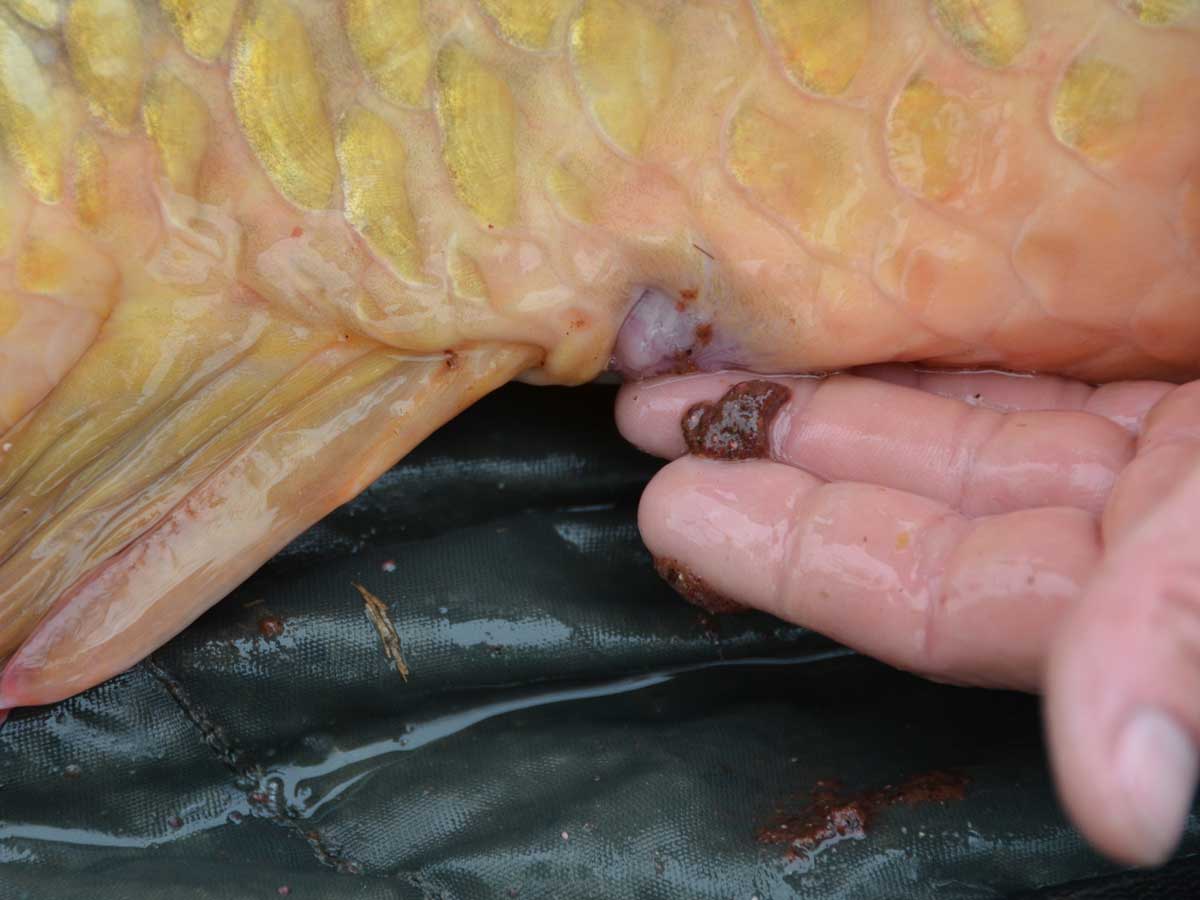
This section comes from a concern the author observed for years at paylakes and other waters.
As a trained fish farmer, he has seen carp with inflammation around the anal opening — directly traceable to poor-quality feed in overstocked waters. And boilies that lay in the water for weeks without being eaten and without rotting — because the propylene glycol content was so high that not even microorganisms could break the bait down.
You can check the digestibility of your bait directly on a caught carp. What the carp excretes reveals more about a boilie than any laboratory analysis: if you still find intact boilie remains, you have a digestibility problem — the ingredients pass through the gut without being utilised. If you find fully digested material, you have a boilie that really works. That is the eat-digest-eat principle in practice: easily digestible boilies leave the digestive tract quickly, the fish gets hungry again and returns to the baited spot.
The clear recommendation: use feeding boilies from a manufacturer you trust — one that speaks transparently about ingredients and takes fish health seriously. If the budget is not enough for quality feeding boilies: better bait with particle baits or pellets. Tiger nuts, hemp and halibut pellets are cheaper than quality boilies — but more honest than cheap feed with questionable ingredients.
Experience feeding boilies live at Carp Austria
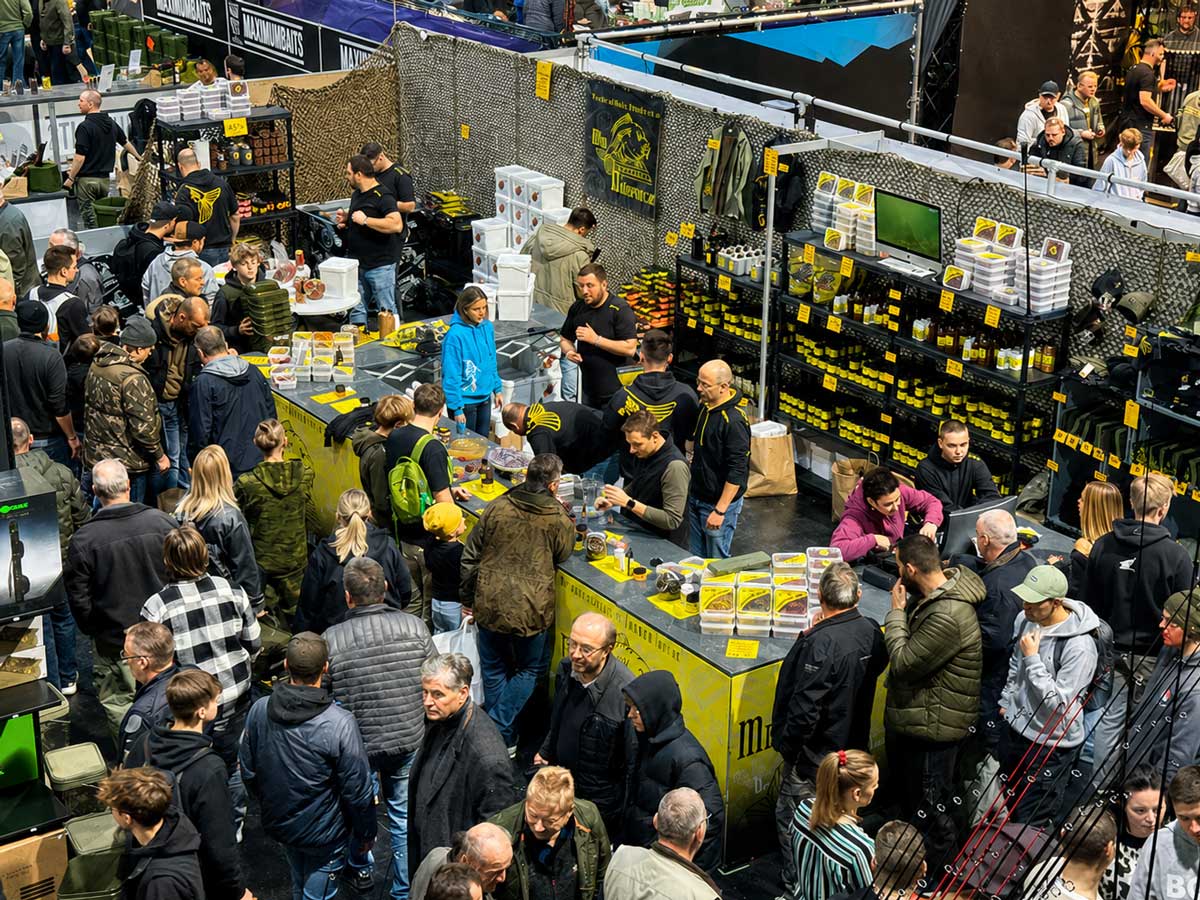
In no online shop and no tackle shop can you take a boilie out of the bag and decide whether it smells good or not. At Carp Austria, you can smell, touch and compare hundreds of feeding boilies — and talk directly to the boilie manufacturer about what is inside, which season it is made for and why.
At Carp Austria — Austria’s largest carp and fishing trade fair with over 9,000 m² of exhibition space — you will find all relevant feeding boilie manufacturers and boilie rolling service providers live: Aquaborne, Aqua Garant, Bait Perfection, Bait Service Straubing, Baitservice Austria, Boilie Academy, CC Moore, Carp’s Kitchen, Hirschbauer Baits, Maximum Baits, Mikbaits, MM Baitservice, NIKL Carp Specialist, R&M Baits, Supreme Baits, Watercraft Boilies and many more. Many bring freshly produced boilie varieties exclusively for Carp Austria visitors — at bulk fair prices you will not get in retail.
Location and timing are the most important ingredients in carp fishing. The feeding boilie comes after that — but it has to be right.